Showing posts with label roger moore. Show all posts

Monday, February 28, 2022

The Wild Geese: Action in Africa

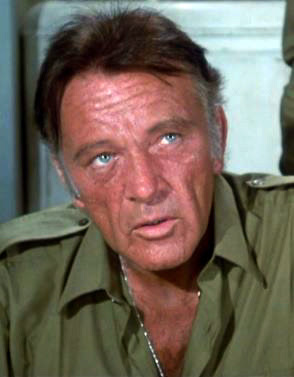
Richard Burton as Faulkner.
When an African dictator's actions threaten to lower British copper prices, influential banker Sir Miles Matheson seeks to discredit the man. Matheson (Stewart Granger) knows that the dictator kidnapped the country's popular president and then spread rumors of his death. So, Matheson contracts with a former Army colonel, Allen Faulkner, to form a mercenary force to rescue the hostage president. 

Faulkner (Richard Burton) reunites with two trusted subordinates: a former captain (Richard Harris), who is an expert at planning complex missions, and an ex-lieutenant (Roger Moore), a highly skilled as a field commander. Their rescue mission goes off without a hitch--until their escape plane lands, turn arounds, and departs without them.

Hardy Kruger.
Made and set in 1978, The Wild Geese is a military action picture along the lines of the superior Where Eagles Dare--which also starred Burton. To his credit, veteran screenwriter Reginald Rose (12 Angry Men) tries to inject some gravitas into the proceedings. For much of the mission, the frail President Limbani (Winston Ntshona) is carried by a prejudiced South African officer (the late Hardy Krüger). Their dialogue inspires the latter to at least reconsider his views. It also elevates The Wild Geese from more conventional run-of-the-mill action pictures.

Roger Moore.
The biggest names in the cast at the time were Burton and Moore (The Spy Who Loved Me came out the previous year). Alas, they're saddled with stereotypical roles: Burton is the crusty leader who inspires loyalty and loves his soldiers; Moore plays the cigar-chewing, devil-may-care adventurer swooned over by the opposite sex. That leaves the juicy roles to Richard Harris and Hardy Krüger.

Harris was the second choice to play Captain Rafer Janders after Burt Lancaster turned down the role. As Janders, a single father devoted to his young son, Harris shows his character's sensitive side--a effective contrast to his military bearing in the field. His nuanced acting reminds one that Harris could be a fine performer when he wasn't slumming in movies beneath him. As for the always reliable Krüger, he creates a believable, interesting character in just a few scenes. It's a model of concise acting. (Incidentally, Krüger and another co-star, Ronald Fraser, appeared together in the earlier classic Flight of the Phoenix).

Richard Harris as Janders.
Andrew V. McLaglen directs with a sure hand, which is unsurprising since he follows a formula similar to his earlier World War II effort The Devil's Brigade (1968). He reteamed with Roger Moore, playing against type this time, in the following year's action picture ffolkes (aka North Sea Hijack).

Although The Wild Geese flopped in the U.S., it was a big hit in Great Britain and easily recouped its cost. A sequel, Wild Geese II, came out in 1985. Burton had agreed to star as Colonel Faulkner again, but died shortly before production began. Edward Fox came on board and played the lead role (but as Faulkner's brother). Roger Moore declined to appear in the follow-up.

Monday, October 11, 2021

Ranking All 25 James Bond Films from Best to Worst

Sean Connery as the movies' first 007.
I originally ranked the first 22 James Bond films back in 2008. After recently watching No Time to Die, I thought it'd be interesting to review my list and update it to include all 25 Bond movies. Surprisingly, my rankings stayed much pretty the same. The two biggest movers were License to Kill and Quantum of Solace, two offbeat series entries which have improved with age. In the list below, the hyperlinks lead to in-depth film reviews by former Café staff writer Sarkoffagus. His assessment of a movie may not always be consistent with mine.

1. Goldfinger (1964) – The ultimate 007 film: terrific pre-title sequence, memorable song, worthy adversaries (Goldfinger and Oddjob), strong women, fun gadgets, clever plot, right mix of humor and action, Shirley Bassey's booming vovals on the title track, and Connery in peak form. Need I say more?

Roger Moore in Spy.
2. The Spy Who Loved Me (1977) – As a fan of The Saint TV series, I thought Roger Moore would be an ideal Bond. But his first two entries had me re-evaluating that assessment; fortunately, this one restored my faith in Roger. He seems incredibly comfortable in the role for the first time. The film also benefits from lush scenery, the most famous henchman of the series, a great Carly Simon song, and Caroline Munro & Barbara Bach (did she ever make another decent film?). I only wish Stromberg was a more compelling villain.

3. From Russia With Love (1963) – Connery’s second-best entry features the meatiest plot of any Bond film. It introduces the trademark gadgets with 007’s versatile attaché case. Lotte Lenya and Robert Shaw (in freaky white hair) score as the villains. The close quarters fight on the train between Bond and Shaw’s henchman is one of the best in the series.

Lazenzy in his solo series entry.
4. On Her Majesty’s Secret Service (1969) – OK, so George Lazenby made a pretty bland Bond. The rest of the film more than compensates for the lack of a dynamic lead. We get Diana Rigg (truly worthy of being Mrs. Bond), a snowy mountaintop headquarters for Blofeld, and some of the most memorable action sequences in the whole series.  Director Peter Hunt, a former editor, was far ahead of his time with his quick-cutting fight scenes. I love the John Barry title theme, but am not a fan of the closing song warbled by Louis Armstrong. Composer John Barry loved it, though, and the song resurfaces in No Time to Die.

5. Casino Royale (2006) – Daniel Craig's first 007 outing remains his best. It’s a muscular Bond film in every way. I even think the poker game—often criticized as the lull point in the film—is exciting. The torture scene goes on too long, but that’s my only qualm. Eva Green easily convinces us why Bond is smitten with Vesper Lynd and Le Chiffre is a worthy 007 adversary. Craig brought an edge to 007 that had been missing since Goldfinger (except perhaps for a brief flare-up in Licence to Kill).

Dalton was growing in the role.
6. Licence to Kill (1989) – It took me several years to warm up to this one. It’s basically a revenge tale and that’s what disappointed me at first. But I later came to appreciate its uniqueness from other Bond films. It’s too bad Timothy Dalton didn’t appear as 007 again. Like Roger Moore before him, I think Dalton was growing into the role and might have had a breakout with his third film. The title song, sung by Gladys Knight, is an underrated gem.

7. The World Is Not Enough (1999) – All right, Denise Richards wasn’t convincing as a physicist and is saddled with the worst name of any Bond character (Christmas Jones, really?). However, we still get Pierce Brosnan in his best 007 outing, along with a great plot twist, a breathtaking pre-title sequence, and strong performances from everyone not named Denise.

Craig as the "blonde Bond."
8. Skyfall (2012) – Daniel Craig’s second Bond film delves deeply into the complex relationship between 007 and M (Judi Dench). That, along with a nail-biting chase through the London Underground, elevate Skyfall into the top third of the Bond filmography. It would rank even higher if it didn't dip into self-importance and borrow Bond’s last stand climax from The Bourne Identity (2002). Adele’s title song is one of the better later themes.

9. For Your Eyes Only (1981) – This was a pivotal entry because it righted the ship after Moonraker steered the series too far into comedy. It’s almost too low-key compared to others, but that works in its favor. Carole Bouquet, Topol, and Julian Glover boost this outing with convincing performances (although former ice-skater Lynn-Holly Johnson is a distraction).

10. Thunderball (1965) – It features most of the virtues of Goldfinger, but has too much of each of them. For me, it verges on being over-the-top, but that’s not to say it isn’t a lot of fun (especially Luciana Paluzzi who steals the film from pretty, but dull heroine Claudine Auger). The underwater climax should be exciting, but everyone moves slower in the water!

Ursula Andress in Dr. No.
11. Dr. No (1962) – The series’ first entry is enjoyable from a historical perspective. It takes awhile to really get going, but Joseph Wiseman sets the standard for Bond villains and Ursula Andress makes the most memorable entrance of any Bond heroine (so much so that Halle Berry pays homage to it in Die Another Day).

12. Octopussy (1983) – This solid outing benefits from Maud Adams in the title role (in her second 007 film) and more screen time for Q. The circus setting near the climax is certainly unusual, but who wants to see James Bond in clown make-up? John Barry’s “All Time High” is easiest his weakest title song.

Pierce Brosnan.
13. Tomorrow Never Dies (1997) – It initially works in fits and starts, but finally gains momentum once Michelle Yeoh’s character gets paired with Bond. Their action scenes are dynamite and their chemistry keeps the plot perking along.

14. The Man With the Golden Gun (1974) – This entry is a hodgepodge that balances Britt Ekland’s bubble-headed heroine and the unnecessary return of Clifton James’ J.W. Pepper with Christopher Lee’s delightful turn as the high-paid assassin Scaramanga and Lulu's blistering version of the title song. I probably rate it higher than most people—but the bottom line, for me, is that it’s consistently entertaining.

Charles Gray as Blofeld.
15. Diamonds Are Forever (1971) – Connery’s much-publicized return after a one-film absence results in a lightweight affair where everyone seems to be having a grand time. Charles Gray steals the film as Blofeld, but, in all honesty, the supporting characters are the attraction here. Who can forget Bond fighting Bambi and Thumper and the amusing dialogue exchanges between henchmen Mr. Wint and Mr. Kidd?

16. Quantum of Solace (2008) – It’s a grim, violent revenge picture from start to finish. It’s imperative that you watch it immediately after Casino Royale, because that film establishes the motivations for Bond’s actions. The first time I saw it, I was unimpressed. However, it has improved with subsequent viewings, likely because I watched it and Casino Royale back-to-back. I also like that it’s an efficient action film (the shortest running time in the series) and Bond’s relationship with the heroine is all business. 

17. No Time to Die (2021) – This fitting conclusion to Daniel Craig’s five Bond pictures starts off promisingly with two gripping pre-title sequences. Once the dust settles, it focuses on Bond trying to find his place in the world as he comes out of retirement to help CIA friend Felix Leiter. Much time is spent on the relationship between Bond and his one-time love Madeleine—who harbors two big secrets. There are some fine set pieces and several delightful homages to previous 007 films. However, Craig and lead actress Léa Seydoux lack chemistry and Rami Malek’s weak villain seems to be channeling Peter Lorre…in a bad way.

Donald Pleasance as the best Blofeld.
18. You Only Live Twice (1967) – Donald Pleasance gets high marks as the series’ best Blofeld and his volcano headquarters (courtesy of set designer Ken Adam) is ingenious. On the downside, Connery looks tired and the climax is a letdown.

19. GoldenEye (1995) – This lackluster debut for Pierce Brosnan has its fans and was a big hit.  However, it feels like a mash-up of previous Bond films. Its highlights are Brosnan, who brought some panache in his 007 interpretation, and Sean Bean as the villain, a former MI6 agent bent on revenge. Incidentally, the GoldenEye video game is famous in its own right and is a personal favorite.

Judi Dench as M.
20. Spectre (2015) – Its first half is full of promise as a posthumous message from M sends James on a mission to expose a mysterious criminal organization. Unfortunately, the second half collapses under its own weight with the revelation that Bond’s evil foster brother is behind every bad thing in 007’s life. It’s a shame because Christoph Waltz is an excellent modern-day Blofeld and the story didn’t need to connect him to Bond.

21. Live and Let Die (1973) – I remember Roger Moore being interviewed when this came out and commenting that Bond films consisted solely of connected chase scenes. Well, the best ones do have a plot! But Live and Let Die has minimal plot and indeed features a ton of chase scenes, most of which are silly (Sheriff J.W. Pepper did not belong in a 007 film!). Yaphet Kotto makes a memorable villain, but needs more to do.

Richard Kiel as Jaws.
22. Moonraker (1979) – I first saw this film at wonderful time in my life and that probably shades my assessment (otherwise, it might be ranked lower). There’s little to recommend it: it’s too spoofy (e.g., the silly use of The Magnificent Seven theme) and it transforms Jaws from bad guy to good guy…with a love interest no less.

23. The Living Daylights (1987) – One of my nephews likes this one and says I need to see it again. I recall it being an uninspired affair except for Dalton, who brought some energy back to the role.

24. A View to a Kill (1985) – It’s hard to decide what’s worse: Christopher Walken’s incredibly campy villain, Tanya Roberts’ non-performance as the heroine, or the fact that Roger Moore seems to be walking through his role. On the plus side, John Barry and Duran Duran collaborated to compose one of the best James Bond title songs--and the only one to hit #1 on the Billboard Hot 100 chart.

25. Die Another Day (2002) – An invisible car? A female spy that’s the equal of Bond? Madonna as a fencing master? These are indications that the producers and writers had run out of ideas and ingenuity. The decision to reboot the franchise with Craig? Excellent!

Thursday, June 1, 2017

In Memory of Roger Moore: The King's Thief

Roger Moore in The King's Thief.
Roger Moore signed a seven-year contract with MGM in 1954 at the age of 27. Although he had studied at the Royal Academy of Dramatic Arts, Moore didn't consider himself a very good actor. But the truth is that he had already developed the on-screen charisma that would define his stardom--well, that along with his good looks.

Roger Moore is not the star of The King's Thief, a modestly-budgeted 1955 costumer about a plot to overthrow King Charles II. Edmund Purdom has the role lead of Michael Dermott, a former soldier loyal to the king who has resorted to robbing wealthy noblemen. One such target is the Duke of Brampton (David Niven), who seems particularly distraught when Michael steals a little black book in addition to some jewels. The book contains the names of influential landowners who support Charles II. Brampton's plan is to dispose of them one by one, claim their estates, and eventually oust the king.

Ann Blyth as Lady Mary.
Meanwhile, Michael meets beautiful Lady Mary, whose father was one of Brampton's first victims. She seeks revenge and recognizes that Michael could be a valuable ally. So where does Roger Moore fit in all this? He plays Michael's right-hand man.

The King's Thief is something of an oddity. Running a scant 78 minutes, it was clearly not intended to be a lavish historical drama on the scale of MGM's Ivanhoe (1952) or Knights of the Round Table (1953). Some of the backdrops give the film a cheap look, although there's a fairly impressive recreation of a medieval town. The film also boasts rich color and was filmed in Cinemascope at a time when that was a luxury.

David Niven as the villain.
Edmund Purdom, who supposedly took over when Stewart Granger dropped out, makes an adequate hero--but there's nothing exciting about his performance. His career in Hollywood was short-lived and it's not hard to see why. However, the rest of the cast is first-class, with David Niven as the suave villain, Ann Blyth as the plucky Lady Mary, George Sanders as Charles II, and, of course, Roger Moore as Purdom's pal.

Purdom and Moore share the film's best scene, a prison escape in which they climb up through a chimney, cross over into a bell tower filled with whistling winds, and then descend from the tower and rooftops.

Roger Moore followed The King's Thief with Diane (1956), another costume drama in which he was third-billed after Lana Turner and Pedro Armendáriz. Still, big screen stardom eluded him and he found work as a regular in 1950s television shows such as Ivanhoe, The Alaskans, and Maverick. In 1962, he was cast as Simon Templar in The Saint TV series...and the rest, as they say, is history.

Sunday, May 24, 2015

DVD Spotlight: Roger Moore as The Saint

Already tired of summer TV offerings from the major networks? Then, you're in luck because the Timeless Media Group will release all six seasons of Roger Moore's The Saint in a deluxe DVD set on May 26th. If you watched one of the 118 episodes each day, that would kept you busy through the summer!

Author Leslie Charteris introduced Simon Templar in his 1928 novel Meet the Tiger, though he considered the short-story collection Enter the Saint (1930) to be Templar's literary introduction. Sometimes labeled the "Robin Hood of modern crime," Templar traveled the globe to deal with gun-runners, corrupt officials, gangsters, and spies. He collected "fees" from the bad guys, keeping some of the money and returning the rest to its owners or donating it to charity. His nickname, The Saint, was derived from his initials S.T. and his calling card featured a stick figure with a halo. Charteris wrotes dozens of Saint short stories and a handful of novels from 1928 to 1964.

George Sanders played The Saint.
The debonair troubleshooter seemed like an ideal candidate for the silver screen and Hollywood came calling in the late 1930s. Louis Hayward became the first actor to play Simon Templar in The Saint in New York (1938), based on a 1935 novel. It's a respectable "B" picture, though I prefer RKO's follow-up Saint films starring the always suave George Sanders. Sanders starred in five Saint films before departing to play a similar detective called The Falcon in another RKO film series. Additional actors who played The Saint on the big screen include Hugh Sinclair (who was quite good), Jean Marais, and Val Kilmer. On the radio, The Saint was voiced by Vincent Price, Tom Conway (Sanders' brother), Brian Aherne, and others.

Roger Moore as Simon Templar.
However, the man that came to own the role was Roger Moore. Surprisingly, Moore was not the first choice for the lead in the 1960s television series The Saint. British TV mogul Lew Grade, who owned the ITV network, originally wanted Patrick McGoohan to play Simon Templar. However, in Burl Barer's comprehensive book The Saint: A Complete History, producer Robert S. Baker said: "We had a talk with Patrick, but we didn't see eye to eye...He 's a marvelous artist, but we thought he didn't have the right sort of panache for The Saint. He didn't have the humor. We wanted to do the show slightly tongue in cheek, we had to have plenty of humor."

Moore as Beau Maverick.
Despite his youthful looks, Roger Moore was a 35-year-old film and TV veteran when he became The Saint. His best-known previous role was as Beau Maverick in the Western TV series Maverick (he essentially replaced James Garner during the show's final year). Prior to that, he had starred in two other TV series: The Alaskans (playing a character called Silky Harris) and Ivanhoe, based on Walter Scott's novel. Moore slipped into the Simon Templar persona effortlessly. Whereas some actors grow into a role, Moore was seemingly born to play The Saint (although his TV character aligned more closely with Charteris' later books as opposed to the earlier ones featuring a tougher Templar).

The first season of The Saint quickly establishes that Simon Templar is both well-known and independently wealthy. In fact, many episodes start with someone recognizing him as "the famous Simon Templar"--at which time a halo appears above his head and the credits roll. The third episode, "The Careful Terrorist," introduces a gruff sidekick named Hoppy (Percy Herbert)--but Hoppy is never seen again. Instead, Simon solves crimes and helps people in need on his own. This meant that Roger Moore was the only series regular for the show's entire run. The only recurring character of note is Templar's nemesis, Inspector Teal (Ivor Dean), who appears in 24 episodes.

Julie Christie in the episode "Judith."
Since Templar was not strictly a detective, the plots could vary widely. Thus, any given episode might find The Saint uncovering a devious scheme to poison a friend ("The Talented Husband"), dealing with kidnappers ("The Latin Touch"), stealing the plans for an invention ("Judith"), or recovering counterfeit plates ("The Work of Art"). By the mid-1960s, The Saint began to reflect the influence of the James Bond movies and The Avengers. In "The Helpful Pirate", British intelligence sends Simon on a mission. And in one of my favorites, "The House on Dragon's Rock," Simon confronts a mad scientist and his creepy creation in Wales (think Them!). There was even an episode about the Loch Ness Monster—which was a popular “guest star” in many 1960s British TV series (e.g., The Avengers, Stingray).

In the U.S., The Saint originally aired as a syndicated TV series, often showing after the local late news. In 1967, with the spy craze fueled by the 007 films, NBC picked up The Saint as a summer replacement series. Its ratings success led to a regular spot on NBC's midseason schedule. The later Saint episodes were filmed in color and shown in over 60 countries. By then, Moore had expanded his role to unofficial co-producer and occasionally director.

When The Saint ended its run, Lew Grade paired Roger Moore with Tony Curtis in a similar series called The Persuaders. Unfortunately, the two actors never clicked and The Persuaders, which only lasted one season, wasn't very good (though it featured a cool John Barry title theme). Moore, of course, went on to play James Bond--a career move that even eclipsed his success as The Saint.

Simon and his Volvo P1800.
Timeless Media's DVD boxed set is nicely packaged in four separate attractive cases. The image quality is excellent (keep in mind that these shows used stock footage for some exteriors, which looked grainy to start with). Roger Moore, with other members of the cast and crew, provides commentary on several episodes. Speaking of guest stars, the lineup is an impressive one and includes Julie Christie, Samantha Eggar, Donald Sutherland, Anthony Quayle, Jean Marsh, and 007 veterans Honor Blackman, Shirley Eaton, Walter Gotell, Julian Glover, and Lois Maxwell. (Click here to check out our video tribute to The Saint's leading ladies.)

The guest stars, the plots, and Simon's iconic P1800 Volvo coupe (with the "ST 1" license plate) are all excellent reasons to watch The Saint. However, you really need just one--and that's the likable, charismatic Roger Moore.

Timeless Media Group provided a copy of The Saint  DVD set for review.

Monday, February 10, 2014

Shirley Eaton Talks with the Café about James Bond, Mickey Spillane, and Her New Book

Think of Goldfinger and the first image that comes to mind is Shirley Eaton--covered in gold paint. If the stunning, talented British actress had appeared in no other films, she would still be famous today. However, prior to her appearance in Goldfinger, Ms. Eaton had established an impressive acting career. In the 1950s, she appeared in two of the Doctor films with Dirk Bogarde and James Robertson Justice. She was the female lead in Carry On, Sergeant, the first of the long-running comedy series, and appeared in two sequels. In the 1960s, she starred in musicals (Life Is a Circus), adventure films (Rhino!), comedies (Eight on the Lam with Bob Hope), and mysteries (Ten Little Indians, my favorite version of Agatha Christie's novel). She retired from acting in 1969 to raise her family. That hasn't kept Ms. Eaton from becoming a sculptor and photographer, penning an autobiography (1999's Golden Girl), publishing a book on poetry, and appearing at film conventions.

Café:  How did you come to be cast as Jill Masterson in Goldfinger?

Shirley Eaton: I had made twenty-one films before Goldfinger and the producers just called my agent to have an interview with me, asking me if I minded being naked and painted gold, to which I replied, with a smile: "Fine, if it is done tastefully."

Café:  You co-starred with Sean Connery in Goldfinger and with Roger Moore on The Saint TV series. How well did you get along with them? And, in your opinion, which was the better Bond?

Shirley Eaton & Sean Connery in Goldfinger.
SE:  Sean was very easy to get on with. He will always be the favourite Bond with older and devoted Ian Fleming fans, so that includes me. Roger made his Bond so different, with more twinkle in his eyes and perhaps we could say a lighter touch than Sean, but millions of fans love him too as I do. He directed one of The Saint episodes I was in and was very understanding "being an actor" and he was a very good director.We have been close family friends ever since The Saint series.

Café:  What do you think of the latest James Bond films with Daniel Craig?

SE:  Daniel Craig is a very good actor and the recent Bond films are great action movies. Inevitably, as time has moved on and fast editing seems a must in most films now, something is lost in essence from the early Bond movies in my opinion.

With Mickey Spillane in The Girl Hunters.
Café:  You starred in The Girl Hunters with Mickey Spillane, who played tough private eye Mike Hammer--his own literary creation--and wrote the screenplay. What was it like acting opposite the film's screenwriter?

SE: I loved working with Mickey Spillane even though he was a better writer than actor. He was a fascinating man, down to earth one minute then away with his imagination the next. His life outside writing was full of adventure and especially courage in the last World War, a man of many talents, he and I made a good combination in the film and he was no mean actor after all!!!

Café:  You appeared in multiple Carry On and Doctor films. Both of these film series were huge favorites with British movie-goers for decades. What was the secret to their enduring popularity?

SE:  Their post card humour, which the English love--not to mention an army of talented actors!

The villainous Su-Muru.
Café:  You made a great (dark-haired) villain in The Million Eyes of Su-Muru and its sequel Rio 70 (aka The Girl from Rio) produced by Harry Alan Towers. Was there any discussion of continuing that film series, as Towers did with the five Christopher Lee Fu Manchu films?

SE:  I had retired by then and wanted to live a normal life again. After I finished The Million Eyes of Su-Muru and The Girl from Rio and was coming home in the plane was when I made the decision to quit. I hated being away from my baby Jason and his brother Grant! However, I did enjoy being the wicked lady Su-muru in two rather bad films, which I had not had the chance to be before. I do believe they have become cult films now :)

(Courtesy of Shirley Eaton)
Café:  After you retired from acting in 1969 to raise your family, were there any roles that tempted you to return to the screen? If so, what were they?

SE:  Absolutely not. I was enjoying life to the fullest just being Shirley Mother and a wife.

Café:  How did you become interested in photography and sculpture? And what can you tell us about your upcoming art/autobiography book Under My Skin?

(Courtesy of Shirley Eaton)
SE:  I went to art school in London for over two years pretty soon after I stopped acting and took painting and sculpture classes. I have always been an extremely creative person and I like artistic challenges, hence you will see in my new book. It is an up-to-date autobiography mostly in a picture form: the first part covering my career and life then and now, with another section on my art then and now, too.

"Sophisticated Me" (courtesy of Shirley Eaton).

You can learn more about Shirley Eaton by visiting her web site www.shirleyeaton.net.

Thursday, August 25, 2011

Bond Is Forever: “A View to a Kill”

Having recovered a microchip in a snowy mountainous region of Siberia, MI6 agent James Bond (Roger Moore) is briefed by Q (Desmond Llewelyn) of the circuit’s likeness to another manufactured by Zorin Industries. The microchip apparently on the open market is suspect, as it has been expressly designed to withstand an electromagnetic pulse. Bond and another agent, Sir Godfrey Tibbett (Patrick Macnee), infiltrate a thoroughbred sale conducted by Max Zorin (Christopher Walken), and learn that he is drugging steeds to fix horse races. When 007’s identity is exposed, he must evade the murderous clutches of Zorin and his partner, May Day (Grace Jones). Bond’s investigation leads him to Stacey Sutton (Tanya Roberts), granddaughter of an oil mogul, who becomes a target for Zorin when a payoff is not as expeditious as the industrialist desires. Zorin’s ultimate goal is Project Main Strike, which would involve flooding Silicon Valley in San Francisco and shifting all the power in the production of microchips to Max Zorin.

A View to a Kill (1985) was the seventh and final film for British actor Moore, who celebrated his 57th birthday during the film’s production. It is undoubtedly one of the least popular films of the series, and the main criticism seems to be the casting of Moore, whose age shows throughout (even the actor himself publicly stated as much). Moore’s charm, however, is as strong as ever. This was also the last movie for the delightful Lois Maxwell as Miss Moneypenny. Including A View to a Kill, Maxwell had appeared in all 14 Bond movies, the only actor to do so. Caroline Bliss took over the role in the subsequent film, The Living Daylights (1987).


Though flawed, A View to a Kill is an underrated entry among the Bond movies. There is depth to the plot, which bounces 007 around to distinctive locales without the impression of a lengthy pursuit, a common complaint for films such as Live and Let Die (1973). A notable factor in the solid story is the inclusion of the KGB. There’s a suggestion that Zorin was trained by the KGB but has since abandoned the agency. When Bond is believed to have been killed, the KGB confronts Zorin and condemns him for authorizing the deed without its permission. The organization becomes a neutral presence, as Bond must intercept a KGB agent (Fiona Fullerton) to stop her from obtaining incriminating evidence against Zorin, evidence that Bond needs for himself. The movie also includes a scene in which M (Robert Brown), Q, and Moneypenny are in the field with Bond, at the racecourse for surveillance, and it’s especially fun to watch Moneypenny cheer for her horse.

A View to a Kill (or at least its title) was adapted from Ian Fleming’s short story, “From a View to a Kill”, which appeared in the collection, For Your Eyes Only. Interestingly, some of the plot owes more to Goldfinger (1964). Zorin’s plan to render Silicon Valley worthless is similar to Goldfinger’s radiation attack on Fort Knox. Likewise, Zorin gathers men to explain the corporation overthrow, and anyone not interested in the endeavor is dropped from his airship. In the same manner, Goldfinger assembled members of the mob to invest in his scheme, and the man who says no thanks is given a ride to the junkyard (though those who invested were not necessarily safe). On the same point, a couple of key criticisms of A View to a Kill involve scenes which share similarities to Goldfinger, elements in the latter film that are generally not denounced. While a villain in A View to a Kill “turns good” near the end, that is essentially what Pussy Galore does (and she is always listed as a Bond Girl, never a villain). And Zorin’s oft-criticized act of gunning down men in cold blood with an uzi can be equated with Goldfinger’s original intention of dropping nerve gas and killing all military personnel at Fort Knox.

But while A View to a Kill maintains a respectable pace and entertains with worthy action sequences, it does have lesser attributes. Yet another disapproval is Tanya Roberts, who is admittedly weak as Stacey. In the same regard, the character of Stacey is nearly insignificant, as she proves helpless in combat or with information. Roberts is undeniably stunning, but Stacey is without substance, and the actress is one of the worst female co-stars in the series. Fortunately, Stacey is hardly in the first half of the film, but, not surprisingly, when she is full engaged in the storyline, the movie decelerates considerably (it’s equally frustrating to watch Stacey wear a hardhat like a baseball cap). An incursion into a mine shaft, for the final action scene, begins leisurely but picks up and concludes explosively.

The disclaimer at the end of the previous Bond outing, Octopussy (1983), te
ased the film as From a View to a Kill, though the “from” would be dropped before the 1985 release. From this film on, the disclaimer in the closing credits states, “James Bond will return,” but does not specify a title.

The title song was performed by pop band, Duran Duran, who also co-wrote with Bond composer John Barry, whose incorporation of the title song into the score is beautifully done. The single reached #1 on the U.S. Billboard charts (the only Bond theme song to ever do so), but with Duran Duran at the height of its popularity, the song’s success was foreseeable. Barry and the band were nominated for a Golden Globe for Best Original Song.

Macnee’s appearance makes yet another connection to the British TV series, The
Avengers. He co-starred with Honor Blackman and Diana Rigg and with Joanna Lumley in The New Avengers. Blackman starred in Goldfinger and Rigg and Lumley (the latter in a small, blink-and-you’ll-miss-her part) were in 1969’s On Her Majesty’s Secret Service.

B-movie action star Dolph Lundgren, who was dating Grace Jones in 1985, has a tiny, nonspeaking role as a KGB henchman for General Gogol (Walter Gotell) and is clearly seen for only a couple of brief moments. This cameo, however, marked his film debut, and he received much more screen time and corresponding acclaim later the same year as Russian boxer, Ivan Drago, in Rocky IV.


It’s certainly not a fan favorite and is frequently placed near the bottom of Bond lists (if not the very bottom), but I enjoy watching A View to a Kill. The action is tight and energetic, Moore’s charisma shines through, and Walken is a riveting foe (I find his discernible voice oddly comforting, an intriguing antithesis to his villainous roles). The film isn’t the best of the series, but it’s also not the worst, and I prefer it over other Bond movies. It’s an admirable farewell to Moore and Maxwell.

Bond Is Forever will return for its final installment next month with Diamonds Are Forever (1971).

Wednesday, June 22, 2011

Bond Is Forever: “Octopussy”

MI6 agent 009 is killed in the course of an assignment, but manages to reach friendly territory before collapsing, where a Fabergé egg is found on his person. The egg is a “near perfect forgery,” while the genuine item is scheduled to be auctioned. James Bond (Roger Moore) and an art expert attend the auction with the hopes of locating the seller. Their intrigue is piqued, however, by Kamal Khan (Louis Jourdan), a notoriously shady seller, who is overbidding for the item in question. Bond bids against him before eventually succumbing and, for good measure, swaps the real egg with the forgery. The agent follows Kamal to Delhi, India, where Bond initiates contact and flaunts that he possesses the real Fabergé egg at a backgammon table. Not surprisingly, Bond incurs Kamal’s wrath and sidesteps bullets, throwing knives and the occasional scimitar. With the belief that the forgeries are funding the Russians, 007 ultimately finds his way to an island of exclusively women, part of a “cult” with members signified by a blue-ringed octopus tattoo and ruled by an enigmatic jewel smuggler known as Octopussy (Maud Adams).

Octopussy (1983) was the second film of the series for director John Glen and also the second appearance for actress Adams, who first starred in 1974’s The Man with the Golden Gun. Octopussy is best remembered -- aside from a title that makes most people blush -- for its release in the same year as an “unofficial” Bond film, Never Say Never Again, starring Sean Connery as 007. The latter film was brought to the screen by producer Kevin McClory, who had worked with Bond creator Ian Fleming and Jack Whittingham on an original story for 007’s cinematic debut. The project was abandoned, resulting in Fleming’s Thunderball, which, in turn, resulted in seemingly endless legal disputes. McClory and Whittingham received credit for additional printings of the novel, as well as the 1965 Broccoli/Saltzman adaptation, and McClory was allowed to make his own version of the movie. The year of 1983 became known as the “Battle of the Bonds.” Both movies performed well, although Octopussy ended with a slight lead, making it into the Top 10 films that year in the U.S. Never Say Never Again performed well and reached the Top 20. (For more on the Thunderball legal wrangling, read about the 1965 film.)


A substantial entry in the series, Octopussy retains a energetic style throughout, and Moore, in his sixth turn as the beloved spy, is just as diverting as when he first stepped into the role. Following the previous Bond film, For Your Eyes Only, in 1981, Moore had technically fulfilled his contract, and EON Productions searched for an actor to portray 007. American actor James Brolin filmed screen tests, including one with Maud Adams (in a scene from 1963’s From Russia with Love) and another with Vijay Amritraj, who stars in Octopussy as Bond’s ally in India. Moore, however, was reportedly asked to return to battle any competition from Never Say Never Again and Connery, the cinematic Bond original. Like the solid For Your Eyes Only, Octopussy keeps the gadgets to a minimum -- the highlight of Q’s (Desmond Llewelyn) anticipated “presentation” of gadgetry is a simple tracking device. In a particularly entertaining sequence, Bond manages to board a speeding train, conceal himself inside a compartment to attain details of a criminal plot, and combat a henchman atop the train still in motion, with nothing more than his expertise and a little savoir-faire.

Louis Jourdan is a charming villain as Kamal, a ferocity teeming just below his handsome exterior. His casual discussion of the manner in which he would torture Bond for information, all while Kamal enjoys a souffle, is both alluring and darkly humorous. Bond’s initial contact in India is Vijay, who’s posing as a snake charmer and plays the Bond theme on the recorder to catch the agent’s attention. Vijay is a delightful supporting character, adept and, like 007, not unaccustomed to fashionable attire. Actor Amritraj was a professional tennis player (as were his brothers, Anand and Ashok), and, in one of the film’s better scenes, he drives an auto rickshaw (with Bond as his passenger) in a high-speed pursuit down Indian streets while simultaneously keeping villains at bay with a tennis racket. Actor Llewelyn is, as per usual, irresistible as Q and has one of the film’s best lines, spoken to Bond after the MI6 agent asks Q to repair a hole in his jacket: “They missed you. What a pity!”

In spite of its ingenuity, Octopussy does stumble before making it to the closing credits. The most significant drawback of the film is its length. It might have benefited from an abridgement, especially considering that the basic plot is finished with approximately 40 minutes remaining, almost giving the impression that the filmmakers were biding their time until they made it to an excess of two hours. There is additionally a rather asinine sequence of Bond being hunted in the jungle, facing such perils as spiders, a snake and a tiger, and all of it culminating in 007 swinging on vines with the Tarzan cry.

Bernard Lee, who had played M in the first 11 movies of the Bond series, died while For Your Eyes Only was being made. M was written out of that film, and Octopussy marks the debut for Robert Brown in the role. Michaela Clavell plays Penelope Smallbone, apparently intended to succeed Miss Moneypenny. However, Lois Maxwell, who’d played Moneypenny in all Bond films up to and including Octopussy, would reprise her role (with no Penelope in sight) for the 14th and final time in A View to a Kill (1985), retiring from the series along with Roger Moore. (Clavell was the daughter of author and filmmaker James Clavell, whose work included writing, directing and producing 1966’s To Sir, With Love.)

The song that opens the film is “All Time High”, sung by Rita Coolidge and written by composer John Barry and award-winning lyricist Tim Rice, who is a frequent collaborator with Andrew Lloyd Weber. It’s a lovely number, reinforced by Coolidge’s warm and resonant voice. At the film’s end, a disclaimer insists that “James Bond Will Return in ‘From a View to a Kill.’” He did indeed, but with a minor title revision.

The title of the movie was taken from a Fleming short story, appearing in the collection, Octopussy and the Living Daylights (sometimes published with a condensed title of Octopussy). In the film, Octopussy reminds Bond of a previous mission involving a Major Smythe (her father), and the assignment to which she’s referring is the plot of Fleming’s short story. The film’s dramatic jumping board -- villains securing funds during auctions -- was taken from another short story, “The Property of a Lady”, which is included in the same collection (although not in the original 1966 edition). The title of said story is referenced in the film as the anonymous seller of the Fabergé egg. Additionally, Bond exposes Kamal’s loaded dice at backgammon and uses them to win a hand, to which Kamal responds by suggesting that he spend his winnings quickly. A similar scene and similar warning occur in the novel, Moonraker, when Bond swindles the cheating Hugo Drax at a card game.

Certainly not as strong as other Bond outings with Moore, such as The Spy Who Loved Me (1977) and For Your Eyes Only, Octopussy will nonetheless quench a 007 thirst. Along the way, fans will find accomplished stars and noteworthy action scenes. And most viewers will welcome the opportunity to watch Octopussy’s girls employ their skills as circus performers or a villain treat a circular saw like a yo-yo.

Bond Is Forever will return next month with Die Another Day (2002).

Wednesday, February 23, 2011

Bond Is Forever: “For Your Eyes Only”

When a British communications device, ATAC (Automatic Target Attack Communicator), is lost at sea, a marine archaeologist, commissioned to help in locating the device, is assassinated. MI6 agent James Bond (Roger Moore), assigned to recover the ATAC, tracks down the assassin but is unable to speak to the man before he is killed by Melina (Carole Bouquet), the marine archaeologist’s daughter. Seeking the man responsible for the hit, both Bond and Melina are led to Cortina in Italy’s Dolomites, where the two must elude various hitmen. A Greek contact/informant, Ari Kristatos (Julian Glover), tells 007 that the man most likely responsible for the theft of the ATAC is Milos Columbo (Topol), who in turn points the finger at Kristatos. Everything comes to a head at a monastery high in the mountains, where Bond and his allies attempt to keep the ATAC from being turned over to the KGB.

For Your Eyes Only (1981) was the cinematic de
but for director John Glen, who’d worked in the capacity of editor and second unit director on previous Bond films and would continue as director for the next four films in the 007 series (to include the remaining films with Moore and both films with Timothy Dalton). The film, a vast improvement over the preceding Bond effort, Moonraker (1979), has a pleasant sense of humor and entertaining action sequences. Interestingly, a skiing scene that leads to a bobsled track is reminiscent of 1969’s On Her Majesty’s Secret Service, on which Glen worked as editor/second unit director. Moore, who has always been memorable in his portrayal of 007, is unmistakably comfortable in the role, and his scenes with Bouquet are highlights, as the couple works well together. Bouquet’s Melina is one of the best Bond Girls: independent, athletic, and unparalleled, all of her qualities exemplified by her chic weapon of choice, a crossbow.


One of the film’s best sequences is when Bond and Melina are tied together and keelhauled (dragged underwater by ship, with marine growth causing serious injury and/or blood in the water and movement attracting sharks). This scene was likely inspired by Ian Fleming’s novel, Live and Let Die, in which Mr. Big dispatches similar punishment to Bond a
nd Solitaire. The sequence in For Your Eyes Only is not only superbly filmed, but it also allows for a terrific line: “Hold tight,” Bond says to Melina, as the line wanes and the two are yanked from the ship’s deck into the water.

Perhaps more importantly, the keelhauling sequence is an expression of Bond’s self-reliance in the film, as he is not dependent upon gadgets. Bond effects escapes and dodges assassination attempts with his skill and cunning. Even Bond’s car, a Lotus Esprit which viewers can assume is armed to the
teeth, has not a chance to display its equipment, as a villain tries to gain entrance by smashing a window and detonates the car and himself. Bond must then evade the bad guys in Melina’s Citroën 2CV, a standard, unfurnished vehicle (though it does prove versatile). When the spy goes to see Q (the always charming Desmond Llewelyn), he receives no gadgets, as he and Q utilize the Identigraph to help identify a potential lead. Bond is supplied with another Lotus, but, like the first one, its presumed accessories are never shown.

The pre-credit sequence features Bond’s nemesis, Blofeld, his face once again unseen, like in the films preceding You Only Live
Twice (1967). The scene also features a reference to Bond’s love, Tracy, from On Her Majesty’s Secret Service. This would be a final farewell to Blofeld, who would not appear in further 007 movies.

Australian actress Cassandra Harris has a small role as a countess and Columbo’s mistress. At the time of filming For Your Eyes Only, Harris was married to actor Pierce Brosnan, who producers hoped would follow Moore as 007. However, Brosnan’s TV series, Remington Steele, conflicted, and the role ultimately went to Dalton. Harris and Brosnan were married until the actress’ death from cancer in 1991. Four years later, Brosnan would finally take over as Bond in GoldenEye.

Lynn-Holly Johnson plays Bibi, an accomplished ice skater and Olympic hopeful sponsored by Kristatos. Johnson was a professional figure skater (her ability is displayed in the film) who made her film debut in Ice Castles (1978), in which she played a young skat
er who overcomes a debilitating accident that renders her blind. In For Your Eyes Only, Bibi is undoubtedly quite young, so much that when she attempts to seduce 007, it’s more than a little disturbing (and a relief when Bond is clearly neither interested nor tempted). Despite playing a juvenile character, Johnson was in actuality only about a year-and-a-half younger than French actress Bouquet, who was Bond’s romantic interest. Bouquet had a successful film career in her native country, winning a César (the French equivalent of an Oscar) for Best Actress for the 1989 movie, Trop belle pour toi (Too Beautiful for You).

Aside from Bond alumni Lois Maxwell as Moneypenny, Geoffrey Keen as the Minister of Defence, Walter Gotell as KGB head General Gogol, and Llewelyn as Q, there are a number of familiar faces in For Your Eyes Only. Glover has had the distinction of appearing in two additional series which were popular with audiences, as Walter Donovan, the antagonist in Indiana Jones and the Last Crusade (1989) and General Maximilian Veers in The Empire Strikes Back (1980). Star Wars fans may also recognize Paul Brooke, playing a man who loses to Bond at the casino table: he was Malakili in Return of the Jedi (1983), keeper of Rancor, the creature whom Luke Skywalker faces in Jabba the Hutt’s pit. Likewise, Jack Klaff, a notable villain in For Your Eyes Only, was a pilot for the Rebel Alliance, call sign Red Four, in 1977’s Star Wars (or, for the purists, Episode IV: A New Hope). Chaim Topol, typically credited as Topol, was Tevye in the award-winning Fiddler on the Roof (1971) and also played Zarkov in the campy Flash Gordon (1980), which has since garnered a cult following.

Bernard Lee, who had played MI6 head, M, in every Bond film up to and including Moonraker, died from cancer in January 1981. In the film, M is on leave, and Bond receives his orders from both the Minister of Defence and M’s Chief of Staff (James Villiers). Robert Brown would debut as M in the subsequent Bond film, Octopussy (1983).

Following the disastrous box office results of Heaven’s Gate (1980), United Artists was essentially bankrupt. For Your Eyes Only was financially successful and helped save the company from bankruptcy, though United Artists was purchased by MGM and future Bond releases would be distributed by MGM/UA and/or would be a co-production.


The film’s title song, written by composer Bill Conti and lyricist Michael Leeson, was performed by Sheena Easton, who, for whatever reason, appears in the opening credits sequence. American rock band Blondie had written a version of “For Your Eyes Only,” but reportedly declined an offer to record the song written by Conti and Leeson. The Blondie song appears on the band’s 1982 album, The Hunter.

For Your Eyes Only is my favorite Bond film with Roger Moore. It is a favorite for my wife as well, although she must suffer through my seemingly nonstop renditions of the title song for a week or two after each viewing. The film boasts reliable characters and story, and action scenes that are profound and, best of all, unadulterated fun. What does everyone else think of Moore’s fifth go-round as James Bond?

Bond Is Forever will return next month with Casino Royale (2006).