Showing posts with label jill st. john. Show all posts

Monday, June 30, 2025

Frank Sinatra as Tony Rome Times Two!

One wonders if Frank Sinatra regretted turning down the lead role in Harper (1966), one of the '60s best detective films. That might explain his decision to star in Tony Rome, another private eye picture, the following year. Although based on a novel by Marvin Albert, Tony Rome comes across as a Harper rip-off with the locale shifted from the West Coast to Miami.

Tony Rome is a former cop who likes gambling, women, and living on a boat. In need of cash, Tony accepts a job from his former partner to return an heiress, who has passed out in a cheap hotel, to her father. The young woman (Sue Lyon) and her wealthy patriarch (Simon Oakland) each hire Tony for different reasons: She wants Rome to recover a missing diamond pin that she was wearing; her father wants the private eye to find out why his daughter has been acting strangely. 

By the time Tony figures what's going on, he's been beaten up multiple times, accused of murder, and nearly killed himself. On the plus side, he has also met a beautiful, very rich divorcee (Jill St. John)!

Gena Rowlands.
Tony Rome is a lightweight mystery with a convoluted plot that doesn't bear close scrutiny. What the screenplay lacks in depth, it makes up for in snappy dialogue ("Miami Beach--twenty miles of sand looking for a city"). An added bonus is the on-location shooting which gives Tony Rome a different look and feel from the multitude of private eye pictures set in and around L.A. 

On the negative side, Tony Rome is sexist and includes at least one racist remark. It's one thing to have a male character leer at a scantily-dressed lady; it's another thing when the camera lingers--close up--on a woman's derriere. Then, there is the 52-year-old Sinatra who has to fight off beautiful women half his age. (Of course, Frank did date the much younger Jill St. John in real life....).

Jill St. John.
Sinatra brings an affable weariness to his performance as the titular detective. The role certainly doesn't require him to bring his "A" game (as he did on other 1960s films like The Manchurian Candidate and Von Ryan's Express). He and leading lady Jill St. John have a nice chemistry (no surprise there...see above); it's too bad that her character has little to do with the plot. 

Gena Rowlands stands out among the supporting cast, but she's barely in the movie. In fact, none of the female characters get much screen time and that includes Sue Lyon and an unbilled Deanna Lund  (according to Tom Lisanti's Fantasy Femmes of Sixties Cinema, the future Land of the Giants TV star was embarrassed with her performance and asked to have her name removed from the credits.)

Despite just middling box office success, Frank Sinatra returned as Tony Rome in the following year's Lady in Cement. The only other holdover from the first film was Richard Conte as Tony's police detective chum and sometime nemesis. 

The story gets underway quickly when Tony discovers the title corpse while scuba diving for sunken treasure. While the police try to identify the victim, an imposing thug named Gronsky (Dan Blocker) hires Tony to search for a missing go-go dancer named Sandra Lomax. Could she be the lady wearing cement shoes?
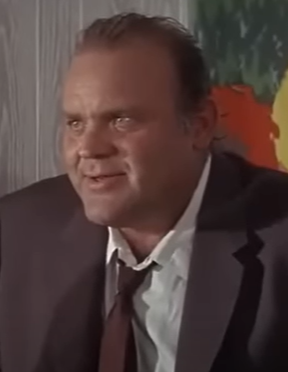
Dan Blocker.
While Tony Rome rates a notch about average, Lady in Cement is a perfunctory private eye picture. In the 1940s, it would have been considered a "B" film. Dan Blocker rises above his material, turning Gronsky into a likable--but still threatening--criminal. Along with Jill St. John, he appeared with Sinatra earlier in Come Blow Your Horn. It's a shame that Blocker, who found television fame on Bonanza, didn't have a a bigger movie career. He died in 1972 at age 43 due to complications following gall bladder surgery.

Raquel Welch and her tall hair.
Raquel Welch doesn't fare as well as Sinatra's leading lady. She plays a character very similar to the one portrayed by Jill St. John in Tony Rome. However, whereas St. John excelled at playing sexy, flirty socialites, Welch struggles to find a groove. Some of her scenes are downright awkward. She was much more effective in later films such as Hannie Caulder (1971) and Kansas City Bomber (1972).

Lady in Cement flopped at the box office and plans for a third Tony Rome film--to be titled My Kind of Love--were scuttled. If you plan to watch either film,  I do need to warn you about the music scores: Tony Rome kicks off with an atrocious theme song suny by Nancy Sinatra whereas Lady in Cement boasts one of the 1960s worst soundtracks courtesy of Hugo Montenegro.

Monday, January 30, 2023

Drama Among the Country Club Set in "Banning"

Wagner as Mike Banning.
Banning (1967) often gets categorized as a golf movie--heck, it was even shown on the Golf Channel at one time. It does involve golfing, particularly during the climax, but the reality is that Banning is the equivalent of a big screen soap opera--and I mean that as a compliment. It's set at a posh Arizona country club whose members include a wily old millionaire, his lonely daughter and conniving son-in-law, a washed-up golf pro, a sultry hussy, and an attractive secretary. These people have settled into their roles at El Presidente until their lives are disrupted by the arrival of Mike Banning (Robert Wagner).

A former professional golfer with a shady past, Banning blackmails club member Jonathan Linus (Guy Stockwell) into hiring him as an assistant golf pro. The good-looking Banning attracts the attentions of Jonathan's ignored wife (Susan Clark) and a wealthy socialite (Jill St. John). However, he has set his sights on Carol Lindquist (Anjanette Comer), the club's secretary who harbors a few secrets of her own. His romantic pursuit of Carol is stifled by the arrival of a mob debt collector. It turns out that Banning owes $20,000 to an old pal whose gambling losses need to paid up or else!

Jill St. John.
If you temper your expectations, Banning is an entertaining lightweight drama that relies heavily on its cast. It's not that it's a particularly well-acted film, but rather its makers chose the right actors for each role. Robert Wagner made a career out of playing the handsome, likable guy with a bit of an edge. Jill St. John always fared best when playing exaggerated characters like Tiffany Case in Diamonds Are Forever. And Susan Clark seemed to specialize in playing strong, intelligent women who were not to be underestimated. Add in a mix of seasoned pros (e.g., Gene Hackman, Howard St. John) and promising young actors (James Farentino) and you've got 102 minutes of fun.

Susan Clark.
Banning was made in the late 1960s when Universal Studios was producing modestly-budgeted films with an eye toward television profits. Many of these pictures were headlined by TV veterans, such as Jack Lord (The Ride to Hangman's Tree), Don Knotts (The Reluctant Astronaut), and Doug McClure (The King's Pirate, a remake of Against All Flags). The studio even made a theatrical film based on its TV sitcom The Munsters (1966's Munster, Go Home!). Thus, it's not surprising that Banning is sometimes misidentified as a made-for-TV movie. (Hey, future spouses Robert Wagner and Jill St. John did star together in a made-for-TV movie that same year: the quirky How I Spent My Summer Vacation).

Make no mistake, though, that Banning was released to theaters--and it's got an Oscar nomination to show for it! Yes, the lovely Quincy Jones-Bob Russell composition "The Eyes of Love" was nominated for Best Original Song (losing to the inferior "Talk to the Animals" from Doctor Doolittle). It's apparent that Banning director Ron Winston knew he had a good song because "The Eyes of Love" is played throughout the movie. Jack Jones and Trini Lopez recorded cover versions of it and Quincy included it on his album You've Got It Bad Girl. However, here's the original version sung by Gil Bernard.

Of course, you could just watch Banning. It was a hard-to-see movie for many years, but fortunately my Twitter pal @CED_LD_Guy has uploaded Banning to his "Your Favorite Movies By Request" Rumble Channel. Rumble is similar to YouTube. To watch the movie, just sign up for a free account, log in, and click on this link.

Wednesday, March 8, 2017

The Liquidator: "Life is not all sex and sun lamps"

One of the first spy spoofs in the wake of Goldfinger (1964), The Liquidator stars Rod Taylor as Boysie Oakes, a reluctant secret agent--or assassin, to be more precise. Boysie enjoys the swinging bachelor pad, the expensive sports car, and the ladies that come with the job. He just doesn't like the killing. So, he sub-contracts out his targets to Mr. Griffen, an efficient blue-collar contract killer. This arrangement works out well until a weekend vacation in Monte Carlo reveals that someone is using Boysie as a pawn in an espionage plot to steal an experimental aircraft.

The Liquidator is an amusing film that borders on satire, a contrast to later (and more financially successful) spoofs like Our Man Flint (1966) and the Matt Helm movies. British intelligence head Wilfrid Hyde-White creates Boysie's job because red tape is preventing his department from catching enemy spies legally. Wouldn't it just be easier to have them killed? His second-in-charge, Mostyn (Trevor Howard), has understandable reservations:

Mostyn:  Chief, this is tantamount to murder.

Chief: Then go find a murderer.

Trevor Howard as Mostyn.
Mostyn remembers Boysie from a World War II incident in which the latter saved the former's life by shooting two spies. What Mostyn doesn't know is that Boysie's gun fired when he tripped on some rubble. He finds Boysie in a rural cafe called the Bird Cage (a probable pun since Taylor had appeared in Hitchcock's The Birds two years earlier). The diner actually features colorful birds in a cage, setting up the film's best double entendre involving a buxom young woman and another word for "bird." Boysie is reluctant to leave his current situation, but once he sees his pad--and the pretty interior decorators--he signs all the government documents without reading them.

Rod Taylor and Jill St. John.
Rod Taylor is the perfect choice for the capable, but not always intelligent, Boysie. Indeed, one of my few qualms with The Liquidator is that I wish the hero had been given a few more heroic things to do. I was surprised to learn that MGM considered making a series of Liquidator films. Unless Boysie evolved into a more realistic spy, I couldn't imagine his character sustaining additional installments.

Of course, there were eight Boysie Oakes novels written by John Gardner between 1964 and 1975. Gardner portrayed Oakes as a cowardly anti-Bond who succeeded as a spy in spite of himself. That may have worked on the printed page (and Gardner is a good writer), but I doubt if movie audiences of the 1960s would have embraced the literary Boysie in a film series.

Jill St. John as Iris.
Speaking of 007, The Liquidator shares some interesting connections with the Bond films. Rod Taylor's co-star Jill St. John would portray Tiffany Case in Diamonds Are Forever in 1971. Lalo Schifrin's theme song to The Liquidator is sung by Shirley Bassey, who recorded the Bond title tunes for Goldfinger, Diamonds Are Forever, and Moonraker. Finally, Ian Fleming's publisher selected author John Gardner to write new 007 novels, starting with 1981's Licence Renewed. Gardner went on to write 13 additional Bond books.

The Liquidator lacks the style and wit of my favorite spy spoof--Our Man Flint--but it's a colorful diversion with a good cast and a decidedly different hero. If you're a fan of 1960s cinema (as I am), then you will likely enjoy it. Plus, you can't dislike a movie in which Trevor Howard wisely notes: "Life is not all sex and sun lamps."

Wednesday, June 29, 2016

Irwin Allen's The Lost World

A dinosaur gets his veggies.
One of my favorite movies as a kid was this 1960 popcorn movie based on the adventure novel by Sir Arthur Conan Doyle. A recent viewing (it's available on Amazon Prime) revealed that The Lost World is less enthralling to the adult me. While that was a somewhat disappointing revelation, I stand by my youthful memories to the extent that I can see its appeal to younger audiences. Plus, it's still a lively affair with a good cast and some nice special effects.

Claude Rains as Challenger.
As with similar fantasy adventures (e.g., Journey to the Center of the Earth), the first third of the plot is devoted to preparing for the expedition. This particular trek leads to a plateau in the Amazon where dinosaurs still roam. The intrepid explorers consist of: Professor Challenger (Claude Rains); a skeptical fellow scientist (Richard Haydn); big game hunter Lord John Roxton (Michael Rennie); journalist Ed Malone (David Hedison); a helicopter pilot (Fernando Lamas); and socialite Jennifer Holmes (Jill St. John) and her Poodle Frosty. (There's also an expendable, greedy guide and Jennifer's brother).

Shortly after the group's landing on the plateau, their helicopter is destroyed by a clumsy dinosaur. Still, getting back to civilization isn't the worst of their problems. There are also giant spiders, cannibals, a volcano on the verge of erupting, a revenge subplot, and the ominously-named "Cave of Fire" (think thin ledges and molten lava).

David Hedison and a pesky dino in the Cave of Fire.
As with 20th Century-Fox's superior Journey to the Center of the Earth (1959), live lizards are substituted for the dinosaurs. Naturally, these creatures can never capture the magic of the imaginative stop-motion creatures created by Willis O'Brien and Ray Harryhausen in, respectively, King Kong (1933) and The Valley of Gwangi (1969). Still, the special effects, courtesy of Fox's resident expert L.B. Abbott, look convincing enough.

Jill St. John and Hedison.
It's the humans that keep The Lost World from being a better movie. Jill St. John is saddled with a silly character that wears pink pants, a pink belt, and pink boots...in the jungle. Even worse, she personifies the extraneous female added to an action movie simply to broaden its appeal. One can understand Challenger's frustrations with her, but his snippy remarks make him sound like a chauvinist pig. Michael Rennie and Fernando Lamas do what they can with their underwritten parts, while David Hedison comes off best as the film's de facto hero.

Ever-resourceful producer Irwin Allen recycled footage from The Lost World in a first-season episode of his TV series Voyage to the Bottom of the Sea (1964-68) entitled "Turn Back the Clock."  Since David Hedison also starred in Voyage, it worked amazingly well. (For the record, Allen also recycled the plot and footage from his 1961 theatrical film Voyage to the Bottom of the Sea in a second season episode.)

A scene from the 1925 version.
According to some sources, Willis O'Brien sketched out sequences for The Lost World, which were never used due to budget constraints. Thirty-five years earlier, O'Brien did the special effects for a silent adaptation of Doyle's novel. Its climax featured a Brontosaurus destroying London--an undoubtedly expensive scene which doesn't appear in the 1960 version.

Doyle's book has served as the basis for several subsequent movies. A 1999 made-for-TV film doubled as the pilot for an Australian TV series based on The Lost World. The resulting series strayed mightily from the book, but retained the characters and was quite entertaining in its own way.