Monday, February 29, 2016

DVD Spotlight on "The Bold Ones: The New Doctors"

On March 1st, Timeless Media will release a DVD set containing all 45 episodes of The Bold Ones: The New Doctors. Debuting in 1969, The New Doctors ran for four seasons on NBC as part of the rotating umbrella TV series The Bold Ones. Last year, Timeless Media released the other three Bold Ones shows: The Senator starring Hal Halbrook; The Protectors with Leslie Nielsen and Hari Rhodes; and The Lawyers headlined by Burl Ives.

These earlier series featured headline-grabbing stories, strong performances, and well-written teleplays. And yet, none of them can match the consistent high quality of The New Doctors. Ironically, it was the one Bold Ones installment I didn't watch regularly when it was originally broadcast. However, after previewing the DVD set, I can state definitively that Timeless Media has saved the best for last.

E.G. Marshall as Dr. David Craig.
Veteran TV actor E.G. Marshall (The Defenders) stars as Dr. David Craig, a middle-aged neurosurgeon who has established the David Craig Institute of New Medicine. As its name implies, the Institute boasts state-of-the-art medical technology and a staff headlined by physicians exploring the frontiers of medicine. Two of Craig's "stars" are Dr. Ted Stuart (John Saxon), chief of surgery, and Dr. Paul Hunter (David Hartman), who specializes in internal medicine. Stuart can be arrogant and blunt while Hunter exudes warmth and quiet intelligence. They share a common passion for research and a desire to treat their patients with understanding and respect.

John Saxon as Dr. Ted Stuart.
This trio of stars differentiates The New Doctors from other medical series from the 1960s and 1970s, which tended to pair a young good-looking doctor with a curmudgeonly mentor (e.g. Dr. Kildare, Ben Casey, Medical Center). The New Doctors also separates itself from similar series by highlighting promising medical advances. In the first season episode "What's the Price of a Pair of Eyes," one of Stuart's colleagues experiments with a sensory device that enables certain blind patients to "feel" images. In "And Those Unborn," Dr. Hunter uses pre-natal genetic counseling to determine the health of an unborn baby. And in "Crisis," Dr. Stuart almost loses a hefty grant because he refuses to perform an experimental heart procedure that hasn't been perfected in humans.

The New Doctors also excels at tackling ethical dilemmas. In one of the best first season episodes, "Man Without a Heart," an attorney (Howard Duff) has a heart attack while cross-examining Stuart during a malpractice trial. When the attorney, now a patient, wants to transfer to the Craig Institute for care, Dr. Craig must decide if the risks outweigh the code of his profession. In another episode, Craig convenes an ethics committee to provide advice on how to handle a sensitive issue. This inside look at the politics and ethical challenges of a major hospital make for compelling viewing.

David Hartman as Dr. Paul Hunter.
All three lead actors are at the top of their game. However, the real revelation is David Hartman's marvelous portrayal of Paul Hunter. To be frank, Hartman never impressed me in TV series such as The Virginian or feature films like Disney's The Island at the Top of the World. However, The New Doctors provides him with an ideal role, allowing him to channel his innate amiability and curiosity. Those same traits also served him well in his follow-up TV series Lucas Tanner (1974-75), in which he played a teacher.

John Saxon left The New Doctors prior to its fourth and final season. Robert Waldenwho would later earn three Emmy nominations for Lou Grant, replaced Saxon as the chief of surgery at the Craig Institute for the show's final 15 episodes. Meanwhile, one of Saxon's first post-Bold Ones roles was as a karate champion in the Bruce Lee martial arts classic Enter the Dragon (1973).

Richard Dreyfus as a season 2 guest star.
The New Doctors' guest stars form a "who's who" of of veteran stars and would-be stars of the 1970s, such as: Milton Berle, Ron Howard, Ida Lupino, Gloria Grahame, Lou Gossett, Jr., Donna Mills, Loretta Swit, DeForest Kelly, Dorothy Malone, Jack Klugman, Julie Adams, and Richard Dreyfus. There's even some star power behind the cameras with Jerry Lewis directing the 1970 episode "In Dreams They Run."

The New Doctors was the only Bold Ones series to last for the umbrella show's entire run. During its first year, The New Doctors rotated with The Lawyers and The Protectors. In season 2, The Protectors was replaced by The Senator. The third season reduced the format to just The New Doctors and The Lawyers and, by the fourth year, only The New Doctors remained. The series was co-created by television legend, Steven Bochco, the creative genius who would later develop Hillstreet Blues, L.A. Law, and NYPD Blue.

The discs include a disclaimer stating the episodes were "mastered from the best available video sources." Overall, the image quality is good, although the color has understandably faded over the last four decades. The only bonus is a good one: the second part of a cross-over episode of Ironside. Of special note, Raymond Burr was an executive producer for The Bold Ones: The New Doctors.

You can view our unofficial trailer for The Bold Ones: The New Doctors DVD set on the sidebar. If using a mobile device, you can click here.

Timeless Media provided a review copy of this DVD set.

Thursday, February 25, 2016

Snack-sized Reviews: "Eye of the Needle" and "Used Cars"

Eye of the Needle (1981). I'm not sure why this well-made suspense picture isn't better known. In many ways, it reminds me of The Day of the Jackal (although it's not quite in that class).

Donald Sutherland stars as Henry Faber, a German spy operating in Great Britain during World War II. Faber learns that an airfield in East Anglia is an elaborate deception to fool the Germans into thinking that an Allied invasion is targeted at a location other than Normandy. For security purposes, Faber needs to personally deliver this vital information to Hitler. However, British Intelligence is closing in around him and he must survive long enough to rendezvous with a U-boat off the coast of Storm Island.

He washes ashore on the isolated island during a raging storm and is found by the Rose family. Lucy (Kate Nelligan) and her husband David, who is mostly confined to a wheelchair, run a sheep farm. David, who once flew airplanes for the RAF, is a bitter man who recoils from the touch of his attractive wife. While David distrusts Faber, Lucy finds herself attracted to the stranger--and the feeling is mutual.

Based on Ken Follett's novel, the first half of Eye of the Needle is a tightly paced thriller in which the ruthless Faber narrowly avoids escape on multiple occasions, leaving innocent victims in his path. The plot takes an intriguing turn when it shifts focus to the relationship between Faber and Lucy. Faber's feelings toward Lucy remain effectively ambiguous all the way through to the climax. Are his actions spurred by sexual gratification alone? Are they driven by years of loneliness created by living a lie? Or has he developed some kind of emotional attachment toward her (I don't think it's love)?

The Isle of Mull.
Donald Sutherland gives one of his best performances and Kate Nelligan, one of my favorite actresses of the 1980s, holds her own. The film also gets a huge boost from Miklos Rosza's lovely score (one of his last) and the stunning scenery. The ficticious Storm Island is "played" by the Isle of Mull. If those haunting seascapes look familiar, then you're probably a fan of Powell and Pressberger's I Know Where I'm Going (1945).

Used Cars (1980). What do Forrest Gump, Snake Plissken, and Laverne & Shirley have in common? If you answered the rowdy cult classic Used Cars, you'd be correct. It was the second film directed by Robert Zemeckis, starred Kurt Russell, and featured Lenny & Squiggy (Michael McKean and David L. Lander) in supporting roles. 

Wanna buy a car from this guy?
Russell plays Rudy Russo, an ultra ambitious used car salesman trying to save $60,000 so he can buy the nomination for a State Senate seat. Rudy will do anything to sell a car! In the hilarious opening montage, we see him rolling back an odometer, fastening a loose bumper with a wad of bubble gum, repairing a tire with "Fix Flat," and spraying "new car scent" into old cars. It's no surprise that the New Deal Car Lot is on probation for consumer fraud. Still, Rudy may be more ethical than Roy L. Fuchs (Jack Warden), who owns the competing Auto Emporium across the street.

Roy has paid off a local politician to learn that a new highway will be coming right through his lot. So, he hatches a scheme to take over the New Deal Car Lot, which, by the way, is owned by his nice-guy twin brother (Warden again, of course). And if it involves causing his brother to have a heart attack, well, that's just business.

Jack Warden as the villain.
If you're looking for subtle high-brow comedy, then avoid Used Cars like one of those car deals that sounds too good to be true. However, if you admire a movie that will do almost anything for a laugh, then you'll probably enjoy this broad farce. For example, when you see a pretty model's dress caught in the trunk of a car during a live commercial, you can guess what's going to happen to that dress. And, yes, that's just what happens. And, while it's a little rude, it is funny.

Kurt Russell and Jack Warden attack their roles with relish and seem to be having a grand time. Still, Gerrit Graham almost steals the film as Russell's fellow huckster and superstitious friend ("Red car is bad luck and trouble"). He and Toby the Beagle have the best scene in Used Cars. Click here to watch it.

Monday, February 22, 2016

The Five Best Music Videos of the 1980s

Guest blogger Emily Anderson lists her picks for the five best classic music videos. What are yours?

Michael Jackson with ghoulish friend.
1. Thriller by Michael Jackson. I remember staying up until midnight at 11 years-old, anxiously awaiting my first viewing of Michael Jackson dancing as a zombie. It was well worth it! This video changed the way music videos were perceived. They were no longer just about music, but were seen as art.

2. Take on Me by A-ha. Without this video, I do not believe this song would be mentioned when discussing 1980s music. This is a prime example of video overpowering song. The mixture of animation and live action is so real that there are times when they are seamless.

The clay Gabriel with big hammer.
3. Sledgehammer by Peter Gabriel. The early days of music videos consisted of performances. As they advanced, videos told stories. Although neither of these formats, Sledgehammer is fascinating. With a clay Peter Gabriel and dancing chickens, there is little this video does not offer.

4. Wanted Dead or Alive by Bon Jovi. There are no gimmicks, flashy dance moves, or animation tricks in this video. It's raw and gritty. The life of top rockers can be rough and the black and white footage adds a nice touch.

The animated Money for Nothing.
5. Money for Nothing by Dire Straits. I wanted my MTV and got it just as this video became popular. At the time, the animation was unique and seemed like a video game instead of a music video. Combined with Dire Straits performing, it had many unsubtle subtleties (like heavy rotation). Complete with singing dog, it is quite amusing.

Honorable Mentions

Story videos: Don't Come Around Here No More by Tom Petty and the Heartbreakers; Land of Confusion by Genesis; and You Might Think by The Cars.

Performance videos: Addicted to Love by Robert Palmer; Every Breath You Take by The Police; and Walk This Way by Run-DMC.

Thursday, February 18, 2016

Shirley Jackson's Chilling "The Lottery"

A crowd gathers for the lottery.
Do you remember Encyclopedia Britannica Films? If you went to school in the U.S. from the 1950s through the 1970s, you never saw a DVD nor probably a videotape. If you were lucky, you might have seen a 16mm film in one of your classes (in my schools, we saw a lot more filmstrips...anyone remember those?). The best 16mm films were the ones produced by Encyclopedia Britannica, especially those that appeared under the "Short-Story Showcase" banner.

As the name suggests, these movies were based on famous short stories, such as Herman Melville's Bartleby and Nathaniel Hawthorne’s Dr. Heidegger’s Experiment. The best--and certainly the most popular in my high school--was a 19-minute adaptation of Shirley Jackson's The Lottery (1969).

William Fawcett as Old Man Warner.
The film opens with townsfolk gathering to participate in a lottery. As they chat among themselves, we learn a lot about the lottery. It always take place on the 27th day of the month. It must happen annually because Old Man Warner has participated in it for 77 years. Other town have lotteries; in fact, one of them is thinking of doing away with it. The lottery may have started as some kind of pagan ritual linked to growing crops (Old Man Warner mumbles: "Lottery in June makes the corn ready soon.").

What we don't learn until the climax is the "prize" for winning the lottery. I won't reveal the answer here for those unfamiliar with this film or Shirley Jackson's (The Haunting) 1948 short story. Let's just say The Lottery would have made a fine Twilight Zone episode if it could have cleared the censors.

Encyclopedia Britannica Films' The Lottery was written and directed by Larry Yust, who may be best known for his photographs today (see www.larryyust.com). Yust was a Stanford University graduate with a degree in theater arts. His father worked as an editor for Encyclopedia Briticannica.

Olive Dunbar as Tessie.
His adaptation of Jackson's short story is a virtual textbook on how to make a first-rate low-budget film. The film takes place entirely outside (no expensive interior sets). It's a dialogue-driven drama. And the excellent cast is peppered with veteran supporting stars, such as Olive Dunbar (ten episodes of My Three Sons), William Fawcett (once a theatre professor at Michigan State), and William Benedict (lots of 1970s television guest appearances). There's also one actor that would go on to fame: 20-year-old Ed Begley, Jr.

Over the the years, I've met quite a few people who saw The Lottery in school. They always remember the ending vividly. If you've never seen it, you can view it here on YouTube (the quality improves after the first two minutes). Just keep in mind that for a movie made for school literature classes, it's pretty potent.

Monday, February 15, 2016

The Movie-TV Connection Game (February 2016 Edition)

What's the link between Clark and Jack?
Welcome to the newest installment of one of the Cafe's most popular features. As always, you will be given a pair or trio of films or performers. Your task is to find the common connection. It could be anything--two stars who acted in the same movie, two movies that share a common theme, etc. As always, don't answer all the questions so others can play, too. There is a single best answer for each question.

1. Clark Gable and Jack Lemmon.

2. Jeanne Crain and Jean Arthur.

3. Christopher Lee, Boris Karloff, and Lon Chaney, Jr.

4. Horror Hotel and Psycho.

5. Imitation of Life (1959) and the film The Godfather.

6. Audie Murphy and Ray Charles.

7. Thunder Road and Big Jake (there are at least two connections, one obvious and the other one kinda fun).

8. Planet of the Apes and Saboteur (an easy one!).

9. Wee Willie Winkie and Imitation of Life (1959).

10. Algiers and The Magnificent Seven.

11. Don Johnson and Kurt Russell.

12. Humphrey Bogart and Rock Hudson.

13. Dirk Bogarde and Steve McQueen.

14. I Was a Teenage Frankenstein and Seven Days in May.

15. Steve McQueen and Robert Fuller.

Thursday, February 11, 2016

Roy William Neill's "Black Angel"

Mavis is about to be murdered.
It's a shame that Roy William Neill never got to direct an "A" film during his tenure at Universal Pictures in the 1940s. I'd rate him as the studio's best low-budget director. His films typically had atmosphere and visual flair to spare. He is best remembered for Frankenstein Meets the Wolf Man (1943) and for helming eleven of the twelve "modern day" Sherlock Holmes pictures starring Basil Rathbone. His finest film may be the Holmes entry The Scarlet Claw (1944), but his last movie, the film noir Black Angel (1946), showed a visual stylist at the peak of his powers.

The film opens with an elaborate tracking shot up the side of a high-rise into the apartment of singer Mavis Marlowe (Constance Dowling). Mavis augments her income via blackmail, so it's not surprising when she winds up murdered. The police arrest Kirk Bennett (John Phillips), one of her blackmail victims who had recently ended an affair with Mavis. Despite his pleas of innocence, Kirk is found guilty of first-degree murder and sentenced to die.

A smiling Dan Duryea.
His wife Catherine (June Vincent) stands by Kirk throughout his ordeal. She never wavers in her belief that he is innocent. As Kirk awaits his execution, Catherine decides to conduct her own investigation. She enlists the aid of Mavis' ex-husband, Martin Blair (Dan Duryea), who reluctantly agrees to help. Catherine and Martin suspect the involvement of a nightclub owner named Marko (Peter Lorre). To collect more information on the mysterious Marko, Catherine and Martin go to work as a singing act at his club Rio's.

Catherine gets the safe combination from Marko.
The screenplay by Roy Chanslor was loosely adapted from Cornell Woolrich's 1943 novel Black Angel, which Woolrich expanded from an earlier short story called Murder in Wax. Chanslor's script actually adheres closer to the short story, which features a doozy of a twist. Both Chanslor and Woolrich have impressive writing pedigrees. Woolrich's literary works provided the plots for a number of memorable films, such as Rear Window, The Leopard Man, and The Window. Chanslor toiled mostly as a screenwriter of "B" movies, but two of his Western novels were adapted as Johnny Guitar (1954) and Cat Ballou (1965).

I'll avoid any plot spoilers here, but will note that Black Angel sports a clever twist, too. However, it may not come as a surprise for discerning viewers. The film provides a pretty good clue right from the outset. In retrospect, the twist negates a large portion of the movie, a tactic that you may find oft-putting. For me, the payoff was worth it.

Dan Duryea gets to play a sympathetic protagonist for once. He teams well with June Vincent, a good actress who spent most of her career working in television (she guest-starred on Perry Mason five times). Alas, the always enjoyable Peter Lorre has little to do as Marko.

Martin is smitten with Catherine.
Roy William Neill is the reason to see Black Angel. He often packs his scenes with information, such as when Martin and Catherine are dancing at Rio's so they can learn more about Marko. As Catherine watches Marko walking down the stairs, Martin turns his eyes to her--a brief look that lets us know he's falling for her. Neill also uses music creatively, starting with the song playing on the phonograph when Mavis' body is discovered. We later learn this song, "Heartbreak," was written by Martin for his ex-wife. Music comes into play again when Martin uses it as a cue to warn Catherine of impending doom as she breaks into Marko's wall safe.

Sadly, Roy William Neill died of a heart attack at age 59. Black Angel indicates that Universal was perhaps considering him for bigger movies. Instead, this interesting film noir represents his swan song.

Monday, February 8, 2016

MOTW: "Seven in Darkness" and "Men of the Dragon"

Seven in Darkness (1969). The first film broadcast by ABC under its Movie of the Week banner is a well-made suspense adventure bolstered by a nifty premise. All the passengers aboard a chartered airplane are blind; they are traveling to a conference in Seattle. When the plane runs into a strong storm, one of the pilots inquires about passengers. The stewardess replies: "Anyone else being tossed like this, I'd have my hands full. But they just sit there...it's kinda creepy."

Milton Berle and Sean Garrison.
Inevitably, the plane--which has gone off-course--crashes into the mountains. The seven people that live are all blind! Alex (Barry Nelson), the group's de facto leader prior to the crash, reminds the survivors: "We're blind, but we're not helpless." Spurred by the dual threats of more bad weather and a pack of hungry wolves (plus the fact that one of them is pregnant), the group leaves the crash site. They press Mark (Sean Garrison), a Vietnam veteran, into a leadership role. He resists it initially, but realizes it's the best course of action for all concerned. He doesn't notice, though, that this sudden change in leadership doesn't sit well with Alex.

There's a lot going on in Seven in Darkness. When the survivors aren't crossing a treacherous bridge with rotted wood, they're bickering among themselves and fending off wolves. Although the characters slip into stereotypes at times, a veteran cast keeps the film on course. Milton Berle, in a rare dramatic role, gets better as the story progresses and Sean Garrison makes a good stalwart hero with a secret. Garrison is perhaps best remembered for his short-lived TV series Dundee and the Culhane, in which he and John Mills played lawyers on the Western frontier. Other cast members include Arthur O'Connell and a blonde-haired Lesley Ann Warren (who gets to sing).

Director Michael Caffey directs with a sure hand, using sounds and images to remind us of the perils faced by the blind survivors. The whistling winds and the distant howls are particularly effective, as is a shot that shows us (but not the characters) that a railroad track being followed leads to a precipice. Incidently, Caffey is the father of Charlotte Caffey, who played in the all-female rock band The Go-Go's.

Katie Saylor gets ready to rumble.
Men of the Dragon (1974). As the Kung Fu craze reached its peak in the U.S., ABC showed this lively made-for-TV variation on Bruce Lee's hit Enter the Dragon (1973). Jared Martin (Dusty on Dallas) and Katie Saylor star as siblings who return to Hong Kong to save a near-bankrupt martial arts school run by a close friend (Robert Ito) and his father. During a shopping excursion, the sister is kidnapped by a powerful villain who aims to sell her as a slave for $1 million. With the help of a kindly brothel madam, the brother and his friend--both martial arts experts--track sis to an island fortified by the bad guy's minions.

Yes, there's not much to the plot of Men of the Dragon--but it provides an adequate framework for the many fight scenes. David Chow, who served as the "technical adviser" on the Kung Fu TV series, choreographed the kicks and punches. The fights may seem pedestrian compared to Lee and his peers, but they're convincing enough and wisely avoid the over-reliance on slow motion employed in the Kung Fu series.

Wiseman in his better known role.
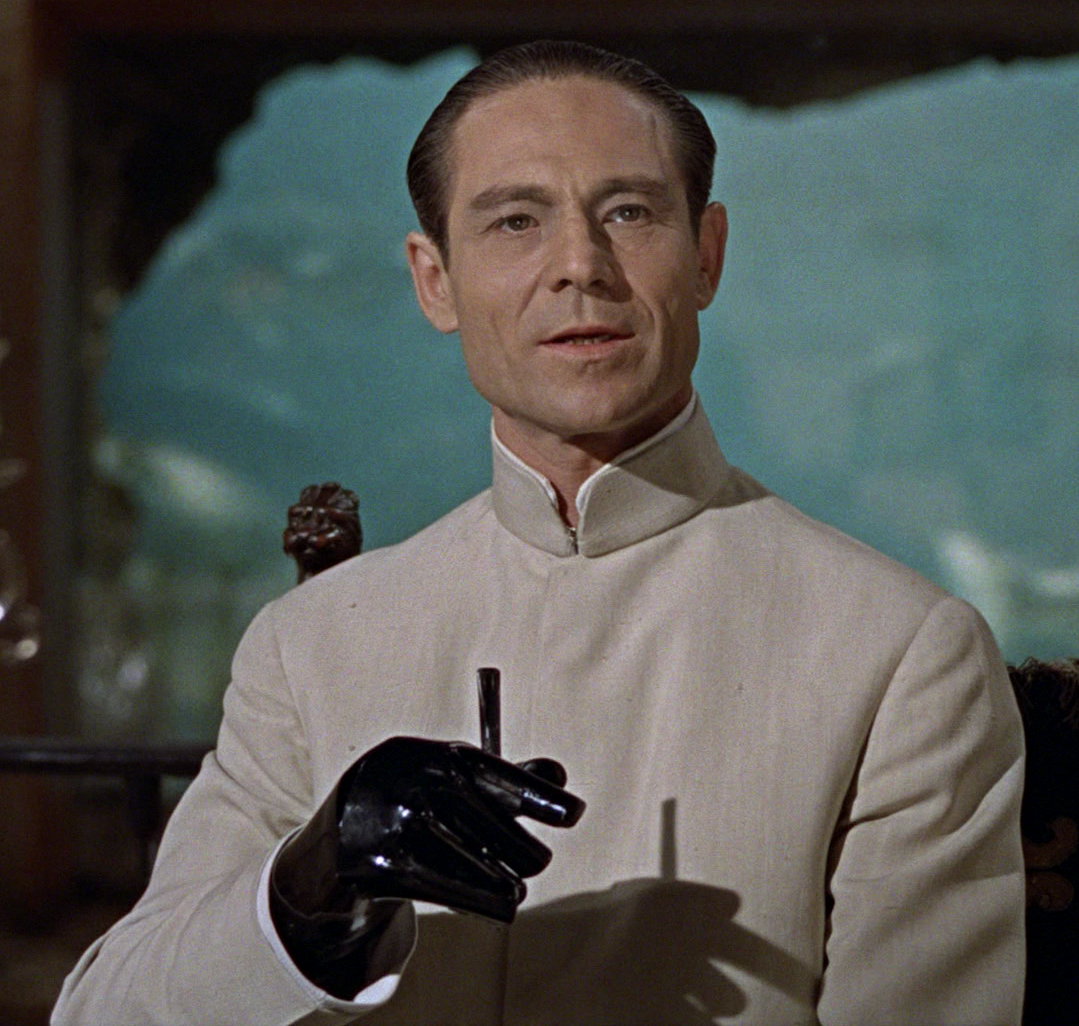
Men of the Dragon is also notable for two other reasonsFirst, it's refreshing to see a female character on 1970s TV trade punches with the male baddies. Granted, Saylor's big fight scene may be brief, but she remains feisty throughout the film. Second, the villain is portrayed by none other than Joseph Wiseman, best known as the title character in Dr. No. He doesn't have much to do here, but he can make any line sound evil!

Jared Martin, Katie Saylor, and Robert Ito look respectable in the fight scenes. I couldn't confirm that any of them practiced martial arts in real life. Martin, who was Brian De Palma's roommate at Columbia, did appear in the 1987 film Karate Warrior. He and Saylor also starred together in the short-lived 1977 sci fi series The Fantastic Journey. Robert Ito is probably best-remembered as lab assistant Sam Fujiyama on Quincey M.E.

Thursday, February 4, 2016

Quentin Durward: The Dying Days of Chivalry

Robert Taylor in the title role.
After Ivanhoe (1952) and Knights of the Round Table (1953), MGM was hoping the casting of Robert Taylor in a third medieval picture would once again generate big profits. Unfortunately, Quentin Durward (1955), which reteamed Taylor and director Richard Thorpe, failed to find an audience. That's puzzling for a movie that boasts colorful scenery, lively swordplay, and an affable cast. It may not be Ivanhoe, but Quentin Durward is an entertaining swashbuckler that deserved a better fate in '55 and should be more fondly remembered today.

Taylor plays the title character, a Scottish knight in 1465 who, by his own admission, was "born perhaps a few minutes too late." Quentin is an honorable, honest, valiant--and also poor--man. Alas, he lives during the "dying days of chivalry" when political intrigue and treachery dominate Europe.

This is not a painting, but one of the real castles used in the film.

Robert Morley as the French king.
His elderly uncle sends Quentin to France to arrange a marriage with the lovely and wealthy Isabelle, Countess of Marcroy. The Duke of Burgundy wants Isabelle (Kay Kendall) to marry Quentin's uncle, but the Countess refuses and seeks the protection of King Louis XI (Robert Morley). The King has his own plans for Isabelle's future and those plans naturally benefit Louis more than Isabelle. Meanwhile, Quentin gains King Louis' confidence and, of course, falls in love with the beautiful countess.

Veteran British actor George Cole.
While the castles and costumes may draw attention, the best swashbucklers rely on likable actors cast in well-written roles (e.g., The Adventures of Robin Hood, Scaramouche). That's good news for Quentin Durward, which provides Taylor with one of his best parts. He hits all the right notes as the valiant knight, but he also finds humor in the character (e.g., Quentin isn't shy about accepting money). Robert Morley softens King Louis' treacherous side by making him a royal rascal. And George Cole steals scenes aplenty as a gypsy who tries to rationalize his good deeds.

Kay Kendall--Grace Kelly was first
offered the part.
While Kay Kendall shows some spunk as Isabelle, the cool beauty lacks the sizzle that Elizabeth Taylor brought to Ivanhoe. That leads to the one significant flaw in Quentin Durward: the lack of a worthy villain. George Sanders was brilliant as the conflicted baddie in Ivanhoe. In his place, Quentin Durward offers a cardboard blackguard played by Duncan Lamont. I think Lamont could have played a worthy adversary, but his role is poorly-written and he's barely in the picture.

Taylor and Lamont do engage in one of my favorite swashbuckler duels. They swing on bell ropes over blazing flames as they lunge toward one another with their weapons. The fight ends too abruptly, but still ranks as one of the most original I've seen. (Click here to watch it on the Cafe's YouTube channel.)

In a 1954 Quentin Durward review, the venerable entertainment industry newspaper Variety wrote: "This lively film version of Walter Scott's Quentin Durward finds knighthood again in bloom with enough dash and costumer derring-do to make fans of swashbucklers happy." That's an accurate summary and, in my book, a pretty good endorsement for watching this forgotten favorite.

Thursday, January 28, 2016

The Best Movies You May Have Never Seen (January 2016)

Recommended and reviewed by Gary Cahall, MovieFanFare

Murder, He Says (1945).  This playfully macabre dark comedy is packed with homicidal hillbillies, a hidden fortune and, maybe, an NPR theme song. A sleepy Ozarks community panics over news that Bonnie Fleagle–part of a notorious local outlaw clan–has escaped prison. Picking that moment to pedal into town is Pete Marshall (Fred MacMurray), a bike-riding polling company survey-taker looking for a missing co-worker. Pete’s backwoods search lands him in the clutches of the aforementioned Fleagles: short-tempered, bullwhip-wielding matriarch Mamie (Marjorie Main, Fred's future The Egg and I co-star); her dim-witted twins Bert and Mert (Peter Whitney) and addled daughter Elany (Jean Heather); and Mamie’s latest husband, toxins expert Mr. Johnson (Porter Hall, the twitchy Macy’s psychologist in 1947’s Miracle on 34th Street).

Twins Bert and Mert (far left and right) were played by Peter Whitney.

The oddball brood's final member, bed-ridden Grandma Fleagle (Mabel Paige), is being slowly poisoned--with a substance that makes her glow in the dark--because she knows where Bonnie and her bank-robber pa stashed $70,000 before being caught. Mamie and company coerce Pete into posing as Bonnie’s boyfriend so that Grandma might confide in him before dying. She gives him a sampler whose stitched musical notes (“To them what doesn’t know the tune, sounds like the ravin’s of a loon”) offer a clue. A hitch arises when the fugitive Bonnie (Helen Walker) arrives...sort of. "Bonnie" is really the daughter of a banker wrongly convicted of aiding the Fleagles. Can she and Pete decipher the nonsensical-sounding lyrics (“Honors flysis, Income beezis, Onches nobis, Inob keesis”) Elany sings to the sampler’s melody?

Like 1940's The Ghost Breakers (which this movie mentions in one scene; both were directed by George Marshall for Paramount), Murder, He Says briskly delivers heapin' helpin's of laughs and chills. Along with a dinner which a Lazy Susan-style table and a poisoned dish turn a gastronomic Russian Roulette game, there are chases through secret passages and a climactic barnyard battle with a hay-bailing machine. The bone-riddled decor of the Fleagles’ run-down abode predates the Texas Chain Saw Massacre house, and a luminous dog–one of Hall’s test animals–running through the woods could have come from The Hound of the Baskervilles.

Helen Walker and Fred MacMurray.
The ever-versatile MacMurray easily goes from befuddled to fearful to heroic without skipping a beat. Leading lady Walker, whose career and personal life never recovered after a 1946 car crash, is a suitably spunky heroine. Main mixes Ma Kettle with Ma Barker as the conniving “poor old lady” who can kill a fly in mid-air with her whip, while shifty-eyed Hall continuously pops up from hidden doorways or tunnels. Best, though, is the hulking Whitney's dual turn as Mert/Bert (the trick photography is convincing, even by today’s standards). When MacMurray asks how you tell them apart, Main explains that Bert has “a crick in his back,” then demonstrates by slapping Whitney’s back…instantly dropping him to his knees in a contorted, immobilized heap.

Oh, and the NPR theme? Listen to Elany sing Gramdma’s song. Doesn’t it sound like the opening notes to “All Things Considered?”
-----------------------------------------------------------------

Recommended and reviewed by Silver Screenings

Scott of the Antarctic (1948).  Have you ever wanted to go on an adventure that tests you so thoroughly you don't know if you'll come through it intact?

If so, you might be interested in the 1948 British adventure flick, Scott of the Antarctic, a grim re-enactment of Robert Falcon Scott's 1911-12 expedition to the South Pole. Scott, a former naval officer, is consumed with being the first person to reach the South Pole.

As you might imagine, Scott and his team are up against it on all sides. Not only must they contend with the weather and inhospitable landscape, they're racing against another team, led by famed Norwegian explorer Roald Amundsen. Amundsen is never shown in the film, but he is an ever-present monkey on Scott's back.

Much of the movie was filmed in the desolate snow of Norway. The actors pull heavy sleds through deep snow and pour tea inside cramped tents. No scenes shot in front of a green screen here; this filmmaking is about authentic as it gets.

It’s not a movie that spares you the savage realities of travelling through the Antarctic. Prior to embarking on his expedition, Scott is advised not to bring motorized sleds. Dogs are much more useful, he is told, because once "a dog is finished, he is still useful to the other dogs."

Man vs. the harsh elements.
Yikes! Now that we've almost frightened you away, let us point out that the acting in the movie is pitch-perfect. Expedition leader Scott is portrayed by the great John Mills who, as it turns out, has a passing resemblance to the real Scott.

Then there's James Robertson Justice, who plays injured team member Evans. In one scene, there is a close-up of Justice against the bitter white snow: his face reveals his determination despite his physical pain; then the realization that he is unable keep up with the others; and, finally, the knowledge that he's going to die, here, at the bottom of the world.

The legendary cinematographer Jack Cardiff has captured amazing images: penguins squirting out of the water and onto the ice; stark white icebergs resting in the ocean; sled dogs breaking out of drifts of snow after a night's sleep.

Scott of the Antarctic is a haunting movie that was the #4 box-office draw in Britain in 1948. It is arguably one of the best adventure movies made.

Monday, January 25, 2016

This Gun For Hire: One of the Great Film Noirs in American Cinema

Alan Ladd in his star-making role.
This practically perfect early noir has a strong reputation and yet, while researching for this review, I was left with the feeling that it's underrated. The prestigious British Film Institute doesn't even include This Gun for Hire (1942) in its list of "10 Great American Film Noirs." (Yes, it would rank in my Top Ten.)

Alan Ladd became a star as anti-hero Raven, a contract killer who is double-crossed by his client. The film's opening scene tells us all we need to know about the quiet Raven. He takes in a stray kitten and feeds it milk. But when the cleaning lady (dressed like a showgirl) shoos away the cat, Raven grabs her, rips her dress, and slaps her backhanded across the face. Here is a man that is ruthless, but with a morsel of humanity buried deep inside. (Later, Raven tries to rationalize his affection for cats by claiming that they bring luck.)

Raven kills the innocent girlfriend.
Still, the screenplay by Albert Maltz and W. R. Burnett leaves no doubt that, first and foremost, Raven is a man that will do whatever is required. Knowing that a victim's innocent girlfriend can identify him, Raven shoots her in cold blood. Later, after vowing not to kill again, he does just that when trying to evade a policeman.

The plot hinges on a chance encounter when Raven and nightclub entertainer Ellen Graham (Veronica Lake) wind up sitting together on a train from San Francisco to Los Angeles. Raven is going to L.A. to find Willard Gates (Laird Cregar), an obvious middleman who hired Raven and then tipped off the police by paying the killer with stolen money. Raven's objective is to find out who Gates works for and then kill Gates and his employer.

Unknown to Raven, Ellen is also traveling to meet Gates, who owns The Neptune Club. A U.S. senator has informed Ellen that Gates is working for a powerful man who is selling a secret formula to the enemy. Ellen's mission is to find out the identity of Gates' employer.

Veronica Lake and Alan Ladd.
The glue that holds the film together is the relationship between Raven and Ellen. From the outset, he is surprised by her kindness. When he steals $5 from her, she demands he return it, but then offers to give him $1. Raven admires her street smarts and, though he's careful never to show it, he undoubtedly finds her attractive. Most importantly, Raven trusts her--enough to describe his abusive childhood (if only in the context of a dream).

Ellen is touched by the fact this hardened killer is willing to confide his darkest secret to her. She is also attracted to his decisiveness and moxie when he rescues her from Gates' henchman. In many films, this relationship would have involved into an unlikely romance. But in This Gun for Hire, Ellen kisses Raven on the cheek and that's it. There are no looks of missed opportunities. Raven is simply not a man that falls in love easily (if at all). And Ellen truly loves her police detective boyfriend (Robert Preston).

Laird Cregar as Gates,
Despite the fine performances from the leads, Laird Cregar almost steals the film as Gates. He's a villain that's willing to send a hired gun to kill people, but wants no part of the actual event. When his henchman is describing how he will skilfully dispose of Ellen's body, Gates squirms uncomfortably and tells him to stop. Cregar provides the film's humor, but in a subtle way that never comes across as obvious comic relief. It's a performance that somehow reminded me of Vincent Price's turn as Shelby Carpenter in Laura (1944).

Director Frank Tuttle and cinematographer John Seitz team up on a number of exciting visuals. The chase through the train yard and the drainage pipes may be the film's highlight, but there are clever bits throughout. My favorite may be a scene where the hotel maid goes to use a pay phone in a police-filled lobby, unaware that Raven is hiding there. He presses his gun against her side as she pretends to talk on the phone. Her phone dialogue consists of answers to his questions. It's a brilliant merger of smart dialogue and murky lighting.

Veronica Lake as Ellen.
John Seitz, by the way, would earn seven Oscar nominations for cinematography during his career. He served as the director of photography on a number of film noir classics, including Double Indemnity (1944), The Big Clock (1948), and Sunset Blvd. (1950).

This Gun for Hire was loosely based on Graham Greene's 1936 novel This Gun for Sale. James Cagney directed a remake in 1957 called Short Cut to Hell, which starred Robert Ivers and Georgann Johnson. It was Cagney's only stint in the director's chair.

Thursday, January 21, 2016

The Five Best Natalie Wood Performances

1. Splendor in the Grass (1961) - Natalie Wood gives a heart-wrenching Oscar-nominated performance as the emotionally fragile Deanie in William Inge's potent tale of young love. The scene where Deanie stands in front of her English class and discusses the meaning of William Wordsworth's "Ode: Intimations of Immortality"--as she tries to hold back her emotions--is masterful. Elia Kazan brought out the best in Natalie in this poignant classic.

2. West Side Story (1961) - One can argue that the role of Maria should have gone to a Hispanic actress or that Marni Nixon deserves more credit for dubbing the singing vocals. Neither of those detract from the fact that Natalie Wood provides the heart and soul of West Side Story. Her scenes with Richard Beymer make one believe that Maria and Tony become soulmates as soon as they spot each other on the dance floor. Watch her expressive face during the climax as she throws herself protectively over Tony's corpse and if you don't sniffle, you're not human.

3. Miracle on 34th Street (1947) - At age 9, she gives one of the best child performances of Hollywood's Golden Era in this holiday classic. Her incredibly natural acting never comes off as artificially cute and she holds her own in the charming scenes with Edmund Gwenn, one of the great character actors.

4. This Property Is Condemned (1966) - I'm not sure why this film and Natalie's performance aren't better known. She stars as Alva Starr, a Southern belle (of sorts) who lives with her manipulative mother (Kate Reid) and idolizing younger sister (Mary Badham) in a railroad boarding house during the Great Depression. Alva could easily have come off as a shallow character, but Natalie turns her into a hard-edged young woman that strives to hide her dreams and insecurities. (By the way, Mary Badham is as good here as she was as Scout in To Kill a Mockingbird).

5. Rebel Without a Cause (1958) - While this is now regarded as, first and foremost, a James Dean film, it launched the "young adult" phase of Natalie Wood's film career. It also earned her the first of her three Oscar nominations for her performance as Judy. Ironically, director Nicholas Ray initially considered Natalie too wholesome and naive for the role. She captures Judy's teen angst beautifully, especially her difficult relationship with her father.

Honorable Mentions: Love With the Proper Stranger (1963), her third Oscar nomination and a fave among her fans; Gypsy (1962); and The Searchers (1956).

Monday, January 18, 2016

Sam Waterston is Q.E.D.

Last year, I reminisced about seven obscure TV shows that I saw long ago and had never seen again. One of them, The Senator starring Hal Holbrook, was released by Timeless Media on DVD last June. I recently discovered that another, Q.E.D., has been uploaded to YouTube.

Sam Waterston stars as Quentin Everett Deverill, a Harvard professor circa 1912 who leaves the university when his colleagues rebuff his idea for a device that can receive transitted signals from an antenna and turn them into a moving image (no TV for them!). Deverill relocates to England to "pursue his studies in private and peace."

However, a newspaper headline about the unexplained disappearance of a yacht skipper catches his attention. When the missing man's sister shows up, Deverill delves into the mystery and unmasks an elaborate plot to destroy London with an explosive rocket. The villain behind this horrid crime is Dr. Stefan Kilkiss, a "brilliant, wicked man...and international saboteur." Matching wits with Kilkiss, the quick-thinking Deverill saves London and escapes from the villain's lair (quite stylishly) in a hot air balloon.

The cast of Q.E.D.
There is much to like about the first episode of Q.E.D., from Waterston's high energy performance to the charming period detail and Julian Glover's broad portrayal of Kilkiss. However, the limitation of the show's concept begins to surface in the second episode, "The Great Motor Race." It's little more than a condensed version of Those Daring Young Men in Their Jaunty Jalopies (1969), though there's a nice twist at the climax. With the exception of George Innes as Deverill's multi-talented assistant Phipps, the supporting characters have little to do other than marvel at the inventor's ingenuity. A casting change doesn't help with the spunky Sarah Berger essentially being replaced by Caroline Langrishe (they play different characters technically, but serve the same function).

The third episode is an improvement, with Deverill being forced to develop a remote-controlled bomb for nefarious uses by Ian Oglivy (the former Simon Templar playing against type). Kilkiss returns for the fourth episode, which boasts the added bonus of being set aboard a train. Both episodes are reasonably entertaining, but it's easy to see why CBS and ITV decided not to renew the series. I suspect that both networks were concerned about whether the show would connect with contemporary audiences. The period sets probably added to the cost of producing Q.E.D. as well.

The bottom line is that Q.E.D. might have fared better as a limited run series on Masterpiece Theatre. That strategy worked amazingly well for other period-set TV series such as the Lord Peter Wimsey mysteries which flourished in the 1970s.

Sam Waterston on Law & Order.
Sam Waterston didn't return to series television until I'll Fly Away in 1991, a short-lived, critically-acclaimed drama about a Southern lawyer in the late 1950s. Of course, he found his greatest success a few years later when he joined the original Law & Order as Executive Assistant District Attorney Jack McCoy. He played the role in 368 episodes spanning seasons 5-20. He also starred as McCoy in seven other episodes of the Law & Order spinoffs and in a made-for-television movie.

Thursday, January 14, 2016

Sands of the Kalahari: Fear Not the Baboons

These aren't Bette Davis eyes.
1965 was a banner year for well-made survivalist adventures. Two of the best-known examples of that subgenre--The Flight of the Phoenix and The Naked Prey--were released that year. A third representative, the lesser-know Sands of the Kalahari, hit theaters as well. It did not click with movie-goers nor critics (Bosley Crowthers of the New York Times wrote: "It is largely a question of who can take the Technicolored agony longer, the characters or the customers"). However, time has been kind to this sometimes brutal film and it has developed a cult reputation over the years.

Susannah York as the lone female.
The opening scenes closely mirror The Flight of the Phoenix with six passengers boarding a small cargo plane for Johannesburg after their commercial flight is delayed. The pilot accepts one final passenger even though he knows it puts the plane over its weight-carrying limit. During the flight, the aircraft encounters an enormous horde of locusts that clogs the engines and sends the plane crashing into the Kalahari desert. The pilots are killed, but the passengers escape before the plane bursts into flames.

A passenger called Sturdevan (Nigel Davenport) emerges as the group's leader. He guides the others to a mountainous area with drinkable water, melons for food, and caves for protection. There is also a congress of baboons (yes, I looked that up) nearby, but the monkeys with the scary-looking teeth only express curiosity about their new neighbors. When Sturdevan leaves the group to seek out help, O'Brien (Stuart Whitman) assumes his role. He heartlessly kills the baboons, explaining that they are the group's competitors for food. However, it gradually becomes clear that O'Brien is an extreme survivalist who wants to get rid of more than just the baboons.

Baboons have sharp teeth!
I recently watched Sands of the Kalahari for the first time in probably two decades. I could have sworn the central premise pitted the passengers against the baboons. I was mistaken, though, for the baboons are not the film's villain; that would be O'Brien. Indeed, although the baboons play a key role in the climax, their primary purpose is to provide an analogy. In describing an article on baboons, a passenger named Dr. Bondrachai (Theodore Bikel) notes: "There is a leader, a king, an absolute monarch. He gets first choice to all the food and the females. And he can only be deposed if he is defeated by a younger and stronger challenger." Bondrachai could just as well have been talking about the his fellow survivors. The only difference is that O'Brien doesn't have to fight his biggest rival, Sturdevan. He just bides his time until Sturdevan  leaves, then O'Brien takes over as the monarch of the group.

In a film with a small ensemble cast, well-drawn characters and strong performances can make all the difference. Fortunately, Sands of the Kalahari features solid veteran British performers such as Stanley Baker, Harry Andrews, Susannah York, and Davenport. They bring their characters to life even though writer-director Cy Endfield fails to flesh their parts out as as skillfully as the survivors in The Flight of the Phoenix.
Director Enfield's numerous overhead shots suggest the baboons
are watching the humans.
Susannah York and Stuart Whitman face the toughest acting challenges. York plays Grace Munden, the lone female character, who displays a lack of moral strength until late in the film. Early on, she attaches herself to O'Brien, either because she wants the brutal hunter's protection or is attracted to his animal quality (or both). As a result, it's hard to empathize with Grace, even though it's conceivable that she has simply recognized her weaknesses and taken the most logical actions required for her survival.

Stuart Whitman as O'Brien.
Whitman initially seems an odd choice for O'Brien (allegedly, Baker, who also co-produced, wanted his friend Richard Burton to play the role). Still, he does an effective job of lurking in the shadows until it's time for O'Brien to take control of the group. Whitman may overplay his part at times, but O'Brien is clearly intended to be a egocentric ruler who believes he has found his destiny.

I'm not surprised that Sands of the Kalahari was a boxoffice failure. The plot borders on grim and brutal at times and it lacks the feel-good ending of Flight of the Phoenix. However, it's a fascinating film that keeps viewers continually guessing what's going to happen next. And when the baboons finally make their presence known in the film's climax, let's just say that it's a confrontation that you won't soon forget.

Monday, January 11, 2016

The Movie-TV Connection Game (January 2016 Edition)

The connection between David Hartman
and George C. Scott?
Welcome to a new year and a new edition of the Cafe's most popular game! As always, you will be given a pair or trio of films or performers. Your task is to find the common connection. It could be anything--two stars who acted in the same movie, two movies that share a common theme, etc. As always, don't answer all the questions so others can play, too. There is a single best answer for each question.

1. Art Carney and Tim Allen.

2. Errol Flynn and Louis Hayward.

3. To Kill a Mockingbird and So I Married an Axe Murderer (this one could be tough!).

4. Fabian and Charles Bronson.

5. Susan Hampshire and Natalie Wood.

6. Glynis Johns and Julie Adams.

7. Billy Wilder and Beach Party.

8. Hal Halbrook and Charles Laughton.

9. John Wayne and Chuck Connors.

10. Dick Powell and Robert Conrad.

11. Bill Bixby and Tony Curtis.

12. Robert Fuller and Gary Cooper.

13. Beau Bridges and Allison Hayes.

14. Ray Milland, Kirk Douglas, and Henry Fonda.

15. David Hartman and George C. Scott.