Monday, March 28, 2022

The Movie Quote Game (Westerns Edition)

This month, we're focusing on quotes from Western films. We will list a quote from a famous Western and ask you to name it. Try to answer these questions on your own without resorting to Google searches. As always, please answer no more than three questions per day so others can play.  If you have a response other than the intended one, just be able to defend it.

1. "What are we going to do with this one, Frank?"

2. "I've heard that you're a low-down Yankee liar."

3. "Don't shove me Harv. I'm tired of being shoved."

4. "Everything happens to me. Now, I'm shot by a child."

5. "I don't like owing anybody any favors. You saved my life back at the hotel. That's all right, I've broken out of Yuma before."

6. " The old man sired two sons. One was no good... never was any good. Robbed a bank...a stagecoach. Then, when he came home and wanted to hide out, the old man wouldn't go for it."

7. "What do I get to eat when I get home in Lordsburg? Nothin' but frijole beans. That's all. Nothin' but beans, beans, beans!"

8. "I ain't gonna slap no leather with you, Doc Frail."

9. "There are two kinds of people in the world, my friend: Those with a rope around the neck, and the people who have the job of doing the cutting."

10. "This is the West, sir. When the legend becomes fact, print the legend."

11. "The old man was right. Only the farmers won. We lost. We always lose."

12. "A game-legged old man and a drunk. That's all you got?"

13. "It's your great ideas that got us into this mess. I never want to hear another one of your great ideas. Ever!"

14. "Well, folks are all gonna miss you around here. All except a few wives, I suppose."

15. "Now remember, when things look bad and it looks like you're not gonna make it, then you gotta get mean. I mean plumb, mad-dog mean."

Monday, March 21, 2022

Master of the World, or 6,000 Feet in the Air

Vincent Price as Robur.
Jules Verne was a hot property in the late 1950s and 1960s, with movie theaters filled with big-budget adaptations of Around the World in 80 Days (1956), Journey to the Center of the Earth (1959), and Mysterious Island (1961). So, it was inevitable that American International Pictures (AIP) would mount its own Verne extravaganza in 1961 starring Vincent Price. As AIP movies go, Master of the World was a classier effort than usual with a literate script by Richard Matheson and decent special effects.

Set in 1868, it opens with the "eruption" of The Great Eyrie mountain in a small Pennsylvania town. John Strock, an agent for the Department of Interior, enlists the aid of two balloonists to investigate the mysterious incident (townsfolk also reported hearing the "voice of God"). As their balloon nears the mountain's crater, it is seemingly shot down from the sky and crashes. 

Strock (Charles Bronson) and the others awaken aboard a flying fortress called The Albatross. The ship's commander is a pacifist called Robur (Vincent Price), who is willing to employ violence to bring peace to the world. He makes his intentions clear when--after warning a battleship to disarm--he destroys the ship and its crew. Can Strock stop Robur before others die in his path of destruction?

The flying fortress Albatross.
Although based on two Verne novels, Robur the Conqueror and its sequel Master of the World, Matheson's screenplay bears more than a passing resemblance to Disney's 20,000 Leagues Under the Sea (1954). Both Robur and Captain Nemo want to end war, both live in fantastic vessels, and are threatened by survivors that they take aboard (portrayed by Bronson and Kirk Douglas, respectively). Whereas 20,000 Leagues employed a sea lion for comic relief, Master of the World uses a French chef!

Also, while Disney's film was a technological marvel for its time, Master of the World has to make do with a modest budget. The special effects range from serviceable (e.g, the Albatross) to woeful (e.g., the flat painting of The Great Erie). Obvious stock footage, mostly from The Four Feathers (1939), is used extensively.

Charles Bronson as the hero.
Vincent Price carries the film with his authoritative presence, whether playing the proud host to his guests or threatening war to end war. Bronson looks bored as the hero, but frankly it's not a well-written part. The rest of the cast includes Henry Hull as a balloonist (and arms manufacturer), Mary Webster as his adult daughter, and David Frankham as her hot-headed fiancé.

AIP considered making a Master of the World sequel at one point. Pre-production artwork exists for a movie titled Stratofin, which would have given Robur a new fantastical ship called The Terror. Alas, the idea was abandoned and we're left with this one and only outing with The Albatross.

Master of the World played frequently on local channels when I was a kid in the late 1960s and early 1970s. I hadn't seen for many years, though, until it popped up recently on a cable channel called ScreenPix.

Monday, March 14, 2022

The Quiller Memorandum

George Segal as Quiller.
When two of its agents are murdered in Berlin, the British intelligence agency MI-6 employs an American spy to locate the headquarters of a 1960s Nazi organization. Known only as Quiller (George Segal), the American follows his own rules--much to the dismay of his British handlers. Instead of pursuing an undercover investigation, Quiller makes his presence known to anyone who might be affiliated with the Nazis. 

He is quickly captured, injected with truth serum, and grilled about the location of the British headquarters. He divulges nothing of interest, but is mysteriously discarded rather than murdered. This is the first indication that Quiller is engaged in a cat-and-mouse game with his query.

Made in 1966, The Quiller Memorandum is one of several serious spy dramas made in the wake of the decade's hugely successful James Bond films. However, despite an impressive pedigree, including an all-star cast and an award-winning screenwriter, The Quiller Memorandum comes across as lightweight compared to The Spy Who Came in from the Cold (1965), The Ipcress File (1965), and The Deadly Affair (1967).

Senta Berger...as a spy?
Part of the problem lies with the simplistic plot, which serves only as a frame for an overdose of dialogue-driven scenes. Nothing much happens in The Quiller Memorandum. Its protagonist walks the streets of Berlin, chats with people, and gets interrogated under the influence of drugs. There's a short feeble car chase and an explosion at the climax, but there's nothing that drives the story nor injects it with any sense of urgency.

Screenwriter Harold Pinter, who adapted the novel The Berlin Memorandum, presents characters with less depth than cardboard cut-outs. Perhaps, his point is that spies lie so much to everyone that their "real" lives cease to exist. However, the end results of his efforts are characters without any character. Quiller is an cartoonish smart aleck who tosses off quips as he sits strapped in a chair facing torture or death. His attitude might work in a Bond knock-off, but obviously The Quiller Memorandum was intended as an anti-Bond spy film.

On the plus side, director Michael Anderson paints a haunting, noirish portrait of Berlin in the mid-1960s--from the crumbling buildings to the late night streets filled with lonely people. The gloom-ridden atmosphere is augmented by John Barry's dour score, which features Matt Monro singing "Wednesday's Child" (Mack David's lyrics include lines like "I am Wednesday's child, born to be alone").

Fans of Alec Guinness, Max Von Sydow, and Senta Berger may be interested in seeking out The Quiller Memorandum. However, if you're in the mood for a good 1960 spy drama, stick with The Spy Who Came in from the ColdThe Ipcress File, or Funeral in Berlin.

Monday, March 7, 2022

The Four Favorite Noirs Blogathon in support of National Classic Movie Day

To celebrate National Classic Movie Day on May 16th, we are hosting the Four Favorite Noirs Blogathon. Per its title, each participating blogger is invited to write about four of her or his favorite film noirs from cinema's classic era. These films don't have to be your all-time favorite noirs--just four that you enjoy and want to share with your readers. Your choices can range from the famous (Double Indemnity) to the lesser-known (Black Angel) and even include international noirs such as Elevator to the Gallows.

If you want to participate, please make sure your blog complies with our blogathon guidelines. Then, leave a comment below with your blog's web address or e-mail it to rick@classicfilmtvcafe.com. When you publish your article on May 16th, please include a link back to this post. We'd appreciate it if you'd post the graphic above to promote the blogathon.

If you don't have a blog, you can still participate by listing your four favorite film noirs on Twitter, Facebook, Instagram, Pinterest, or another social media platform. All we ask is that you wait until May 16th to do so.

Finally, since National Classic Movie Day is all about our love of classic movies, it's a great day to introduce a friend to the wonderful films from the silents to the 1970s!

Here are the participating bloggers so far:

4 Stars Films

Backstory Classic

Classic Film Addict

Classic Film & TV Cafe

Crítica Retrô

Hamlette's Soliloquy

Hometowns to Hollywood

In the Good Old Days of Classic Hollywood

Lady Eve's Reel Life

The Last Drive-in

Make Mine Film Noir

Once Upon a Screen

A Person in the Dark

Phyllis Loves Classic Movies

Realweegiemidget Reviews

Reel Charlie

Shadows and Satin

Silver Screenings

Taking Up Room

This n' That: A Potpourri of Books, TV, Movies, Life & Fun Things

Whimsically Classic

Wonderful World of Cinema

Monday, February 28, 2022

The Wild Geese: Action in Africa

Richard Burton as Faulkner.
When an African dictator's actions threaten to lower British copper prices, influential banker Sir Miles Matheson seeks to discredit the man. Matheson (Stewart Granger) knows that the dictator kidnapped the country's popular president and then spread rumors of his death. So, Matheson contracts with a former Army colonel, Allen Faulkner, to form a mercenary force to rescue the hostage president. 

Faulkner (Richard Burton) reunites with two trusted subordinates: a former captain (Richard Harris), who is an expert at planning complex missions, and an ex-lieutenant (Roger Moore), a highly skilled as a field commander. Their rescue mission goes off without a hitch--until their escape plane lands, turn arounds, and departs without them.

Hardy Kruger.
Made and set in 1978, The Wild Geese is a military action picture along the lines of the superior Where Eagles Dare--which also starred Burton. To his credit, veteran screenwriter Reginald Rose (12 Angry Men) tries to inject some gravitas into the proceedings. For much of the mission, the frail President Limbani (Winston Ntshona) is carried by a prejudiced South African officer (the late Hardy Krüger). Their dialogue inspires the latter to at least reconsider his views. It also elevates The Wild Geese from more conventional run-of-the-mill action pictures.

Roger Moore.
The biggest names in the cast at the time were Burton and Moore (The Spy Who Loved Me came out the previous year). Alas, they're saddled with stereotypical roles: Burton is the crusty leader who inspires loyalty and loves his soldiers; Moore plays the cigar-chewing, devil-may-care adventurer swooned over by the opposite sex. That leaves the juicy roles to Richard Harris and Hardy Krüger.

Harris was the second choice to play Captain Rafer Janders after Burt Lancaster turned down the role. As Janders, a single father devoted to his young son, Harris shows his character's sensitive side--a effective contrast to his military bearing in the field. His nuanced acting reminds one that Harris could be a fine performer when he wasn't slumming in movies beneath him. As for the always reliable Krüger, he creates a believable, interesting character in just a few scenes. It's a model of concise acting. (Incidentally, Krüger and another co-star, Ronald Fraser, appeared together in the earlier classic Flight of the Phoenix).

Richard Harris as Janders.
Andrew V. McLaglen directs with a sure hand, which is unsurprising since he follows a formula similar to his earlier World War II effort The Devil's Brigade (1968). He reteamed with Roger Moore, playing against type this time, in the following year's action picture ffolkes (aka North Sea Hijack).

Although The Wild Geese flopped in the U.S., it was a big hit in Great Britain and easily recouped its cost. A sequel, Wild Geese II, came out in 1985. Burton had agreed to star as Colonel Faulkner again, but died shortly before production began. Edward Fox came on board and played the lead role (but as Faulkner's brother). Roger Moore declined to appear in the follow-up.

Monday, February 21, 2022

The Movie Quote Game (Alfred Hitchcock Edition)

This month, we're focusing on quotes from Alfred Hitchcock films. We will list a quote from one of his movies and ask you to name it. Try to answer these questions on your own without resorting to Google searches. As always, please answer no more than three questions per day so others can play.  If you have a response other than the intended one, just be able to defend it.

1.  "Last night, I dreamt I went to Manderley again."

2. "What are you doing here in Bodega Bay?"

3. "Mr. Rusk, you're not wearing your tie."

4. "You want a leg or a breast?"

5. "Whether you killed him or not, you've incriminated yourself. You'll have much more of a job explaining a body you didn't kill and buried than a body that you killed accidentally and buried."

6. "Oh, it's just like Sherlock Holmes and his fiddle. A stream of beautiful sound and then suddenly out pops the solution."

7. "Boris? Miss Henderson speaking. Look, someone upstairs is playing musical chairs with an elephant. Move one of them out, will you? I want to get some sleep."

8. "Hello, Monkeyface!"

9. "If I let you change me, will that do it? If I do what you tell me, will you love me?"

10. "You Freud, me Jane?"

11. "I've always wished for more artistic talent. Well, murder can be an art, too. The power to kill can be just as satisfying as the power to create."

12. "My theory is that everyone is a potential murderer."

13. "What are you doing here? It's rather a long story, Mr Fry. It all started with an unknown blonde, an aircraft worker at a factory in Glendale, California."

14. "She's too perfect, she's too talented, she's too beautiful, she's too sophisticated, she's too everything but what I want."

15. "God bless Mama, Papa, Captain Midnight, Veronica Lake, and the President of the United States."

Monday, February 14, 2022

Abbott and Costello's The Time of Their Lives

Bud and Lou in one of their few scenes together.
One of Abbott and Costello's most atypical films ranks among their best. The Time of Their Lives (1946) is one of only two of the pair's movies in which they don't perform as a team. The previous year's Little Giant is the other non-comedy team picture. In real life, the two actors were in the middle of a rift.

The Time of Their Lives casts Lou as Horatio Prim, a patriotic American tinker during the Revolutionary War. Horatio is enlisted by the upper-class Melody Allen (Majorie Reynolds) to warn George Washington of a treasonous plot involving her fiancé Tom Danbury. However, while Melody and Horatio are departing the Danbury estate, they are pursued by a band of men. Following an exchange of gunfire, Horatio and Melody are killed--by other patriots who assumed they were traitors. Their bodies are dumped into a well and cursed to wander the estate until the "crack of doom" or until their innocence can be proven.

Lou Costello as Horatio.
Horatio's and Melody's ghosts spend most of the next 166 years residing in a tree on the estate following the mansion's destruction in a fire. However, in 1947, they take an interest when a playwright named Sheldon Gage rebuilds the grand house and restores some of the original furnishings. It gives Horatio and Melody hope that they may be able to find a letter from Washington that proves Horatio was not a traitor. That letter would free them from their curse.

While Lou Costello still cracks one-liners and performs pratfalls, The Time of Their Lives is a charming change-of-pace comedy fantasy. Bud Abbott benefits the most, as he gets to play double roles: a conniving manservant in 1870 who dislikes Horatio and a contemporary psychiatrist who takes a big risk to help the friendly ghosts. It's especially refreshing to see him as the latter, a likable character distinctly different from his usual roles.

Marjorie Reynolds as Melody.
Marjorie Reynolds essentially plays Lou's straight man. On screen, the couple project a sweet affection for one another. There's even a hint of romantic feelings between the two ghosts, though that angle is jettisoned awkwardly when Melody learns of her fiancé's regrets. It's really the only misstep in an otherwise well-written script.

The ghostly special effects are impressive for the most part. A highlight is when Horatio and Melody walk "through" each other and exchange clothes. Such effects required the actors to perform the same scene multiple times. That created a problem because Costello often liked to take props as souvenirs from his movies. In one instance, his pilfering of a prop destroyed a scene's continuity and wasted a day of filming.

Marjorie Reynolds retired from movies in the early 1950s. Despite promising roles in "A" pictures like Holiday Inn (1942) and Ministry of Fear (1944), she never became a star. She transitioned successfully to television, though, as William Bendix's wife in the NBC series Life of Riley (1953-58). She also appeared in occasional guest star roles in TV shows like Leave to Beaver and, notably, The Abbott and Costello Show

The Time of Their Lives did not perform at the box office as well as Abbott and Costello's other comedies for Universal. Still, the team got back on track later in 1947 with The Wistful Widow of Wagon Gap, an amusing Western comedy co-starring Majorie Main. And in 1948, they would star in their biggest hit of all: Abbott and Costello Meet Frankenstein

Monday, February 7, 2022

Seven Things to Know About Richard Long

1. In his film debut, Richard Long played the adult illegitimate son of Claudette Colbert and Orson Welles in the 1946 drama Tomorrow Is Forever. He was fifth-billed in the cast, which also included George Brent, Lucille Watson, and Natalie Wood as Orson's eight-year-old foster child in the movie. Incidentally, Long acted opposite Welles in his follow-up film The Stranger, which Orson also directed.

2. Richard Long's fourth film provided him with his most famous film role. In The Egg and I, he played Tom Kettle, the oldest son of the quirky country couple Ma and Pa Kettle (Marjorie Main and Percy Kilbride). The Kettles stole the movie from stars Claudette Colbert and Fred MacMurray and earned their own film series. Starting with Ma and Pa Kettle (1949), Long appeared in four of the nine Kettles films as Tom, a bright young man who eventually attends Washington State University, gets married, and moves to New York City.

3. Richard Long's first significant television role was as Gentleman Jack Darby in four 1958-1959 episodes of Maverick. Darby was a fugitive wanted for embezzlement. Though he was innocent of that crime, Darby was a smooth con man, who sometimes teamed with his entertainer girlfriend Cindy Lou Brown (Arlene Howell). Long was cast as Darby after Efrem Zimbalist, Jr. became one of the stars of 77 Sunset Strip. Zimbalist had played a similar character named Dandy Jim Buckley. Incidentally, Long played Gentleman Jack along Zimbalist's Dandy Jim in "Shady Deal at Sunny Acres," James Garner's favorite Maverick episode.
The cast of Bourbon Street Beat.
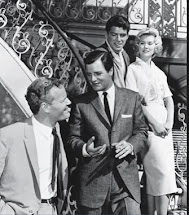
4. Following their appearances together on Maverick, Warner Bros. cast Richard Long and Arlene Howell in the New Orleans-set detective TV series Bourbon Street Beat (1959-60). Long played private eye Rex Randolph with Andrew Duggan as his partner, a former police officer. Arlene Howell co-starred as their secretary and Van Williams played Kenny Madison, a law school graduate turned PI. Bourbon Street Beat did not fare as well as other Warner Bros. detective series and was cancelled after a single season. However, Richard Long's character, Rex Randolph, joined 77 Sunset Strip for a season and Van Williams returned as Kenny Madison the following year in a new series called Surfside 6.
Long as Jarrod Barkley.
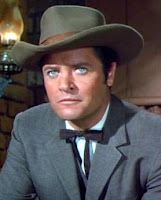
5. In 1965, Richard Long signed on to play Jarrod Barkley, Victoria Barkley's (Barbara Stanwyck) oldest son in the popular Western TV series The Big Valley. Jarrod was an atypical Western TV character, having graduated from law school back East before returning to the Barkley ranch in Stockton, California. During the series' four-year run, Jarrod is the only family member to get married (in the third season episode "Day of Wrath"), though his young bride is quickly murdered. Long also directed two episodes of The Big Valley: "The 25 Graves of Midas" in season four and "Plunder!" in season two.
Juliet Mills and Richard Long.
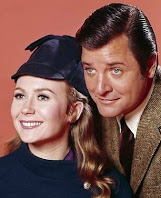
6. In a 2020 interview with Jeremy Roberts, Linda Evans described her Big Valley co-star: "Richard was like a giant teddy bear. You just wanted to hug him. He was a joy. He was funny. He was smart. He was someone that you could sit down with and feel that you had known forever. You could trust him with your life." Juliet Mills, Long's co-star in the TV series Nanny and the Professor (1970-71) told Closer Weekly in 2019: "Richard was a wonderful light comedian, a lovely man, and all of his family became friends. He died when he was 47, but if he’d lived longer, he would have been more appreciated. Just a lovely, sweet guy."

7. Richard Long was married twice. His first wife, actress Suzan Ball, was a second cousin to Lucille Ball. She was diagnosed with cancer in 1953 and died at age 21 a year after she and Long married in 1954. Richard Long married actress Mara Corday in 1957. They had three children and, despite some volatile stretches, remained wed until his death in 1974. Richard Long experienced cardiac problems for much of his life and suffered his first heart attack in 1961. He checked into a hospital in 1974 for heart-related problems and died four weeks later at age 47.

Monday, January 31, 2022

Sandy and Bobby Have That Funny Feeling

Sandra Dee dressed for success.
Imagine a Doris Day-Rock Hudson romantic comedy with Sandra Dee in the Doris role, Bobby Darin in lieu of Rock, and Donald O’Connor replacing Tony Randall as the friend with the timely one-liners. That’s pretty much what you get with the 1965 comedy That Funny Feeling

Sandra Dee plays Joan, an aspiring actress who works as a maid in NYC. One of her housekeeping clients is executive/playboy Tom Milford (Bobby Darin), whom she has never met. When Tom thinks he’s going on a 10-day business trip, he telephones Joan so she knows cleaning services won’t be needed. 

A baffled Bobby Darin.
Over the next couple of days, Joan and Tom bump into each other multiple times and sparks fly—though Joan keeps her job a secret and neither reveals their last names. When Tom insists on escorting her home after an impromptu date, Joan panics. She doesn’t want Tom to see the ugly, little apartment that she shares with a friend. Remembering that her client is on a business trip (or so she thinks), she has Tom take her home to his apartment. He is understandably confused, but decides to play along. The situation escalates when Joan and her friend temporarily move into Tom’s place and he moves in with his boss (Donald O’Connor). 

It’s a silly premise, but still amusing and well executed. Dee and Darin, who were married at the time, are a likable screen couple. While they lack the exquisite comedy timing of pros Day and Hudson, they carry off the wacky situations with earnest appeal. They also have two factors working in their favor: a tight running time of just over 90 minutes and a delightful supporting cast. The latter includes: Nita Talbot as Joan’s pragmatic friend, Larry Storch as a neighbor (who needs more screen time), Leo G. Carrol as a Scottish pawnbroker, and Robert Strauss and Ben Lessy as bartenders commenting on the shenanigans. 

Donald O'Connor as Darin's boss.
Surprisingly, Donald O’Connor seems a little lost as Tom’s baffled boss and friend. Tony Randall played similar roles in Pillow Talk and Lover Come Back, but imbued them with an enthusiastic zeal that the typically reliable O’Connor lacks. It was his first film after a four-year hiatus from the big screen. 

That Funny Feeling could have also benefitted from more attention to detail. Joan is supposed to be a working girl with a tight budget, but Sandra Dee wears a number of fabulous outfits designed by Jean Louis. Then, there’s the case of the disappearing dog. After introducing Tom’s Labrador Retriever, Spike, the canine gets handed off to a bellhop and never appears again. We dog lovers want to know what happened to Spike!

In addition to starring opposite his wife, Bobby Darin also wrote the score, composed the theme song, and sang it. Amazingly, he wasn’t the first choice for the role, despite previously teaming with Sandra Dee in If a Man Answers (1962). One of the first choices for That Funny Feeling was Warren Beatty.


Monday, January 24, 2022

The One That Got Away

Hardy Krüger as von Werra.
It'd be hard to make up a story as exciting and unlikely as The One That Got Away (1957), the true tale of a German prisoner-of-war (POW) who escaped from the British army in 1940. 

Lieutenant Franz von Werra's exploits begin when his plane is shot down during the Battle of Britain. After landing safely in the English countryside, he is captured, interrogated, and sent to a country manor being used as a POW camp. Von Werra's first escape glistens with simplicity: During a rest break during an exercise march, he rolls over to the other side of a stone fence. As his compatriots march away, he runs towards the forest in the opposite direction, partially hidden from view by the fence. Despite his efforts to reach the coast, the British capture von Werra five days later.

That does not dissuade the confident German from trying to escape again...and again...and again.

Based on the book by Kendal Burt and James Leasor, The One That Got Away seems like an unlikely film to be made in the mid-1950s. After a bitterly-fought war with Germany that ended barely a decade earlier, here's a British-made movie with a German officer as its de facto hero. To be sure, Lieutenant Franz von Werra was not a Nazi, but he did shoot down numerous British planes. Initially, the film's producers considered casting a British actor in the lead, specifically Kenneth More or Dirk Bogarde. Fortunately, a German actor--Hardy Krüger--was cast in the title role.

Krüger, who was fluent in German, English, and French, had acted in German films previously. His bigger-than-life performance as the unflappable von Werra is the heart of The One That Got Away. He manages to project complete confidence without coming across as smug and, most importantly, convinces the audience to root for his character. When von Werra reminds a British officer that it's his duty to escape, the German officer isn't throwing off a wisecrack. He's just being factual (though it lands him 21 days in solitary confinement).

His performance made Hardy Krüger an English-language star and he followed up The One That Got Away with the romantic comedy Bachelor of Hearts (1958). He quickly became the go-to actor for any international films with significant roles for a German character. His most notable movies are Hatari! (1962), Sundays and Cybele (1962), and The Flight of the Phoenix (1965)--which features my favorite Krüger performance.

Hardy Krüger is reason enough to see The One That Got Away, but it's also a rousing story that will hold your attention. Plus, it's the kind of fact-based drama that will have you researching to find further details of von Herra's amazing tale.

Monday, January 17, 2022

The Alternate Movie Title Game (Vincent Price Edition)

Here are the rules: We will provide an "alternate title" for a Vincent Price film and ask you to name the actual film. Most of these are pretty easy. Please answer no more than three questions per day so others can play. You may have an answer other than the intended one--just be able to defend it!

1.  A Lady's Portrait.

2.  $10,000 for the Night.

3.  Morgan.

4.  City Beneath the Sea (might be a hard one!).

5.  Dirty Waters.

6.  Prospero's Ball.

7.  The Great Swindle.

8.  The Plagues of Egypt.

9.  Sisters By the Sea.

10. Die, Critics, Die!

11. The Man Who Vanished.

12. The Spider Web.

13. Robur the Conqueror.

14. The Celestial Tribunal.

15. The Devious Professor Ratigan.

Monday, January 10, 2022

Mad Max Ventures Beyond the Thunderdome

Mel Gibson as Max.
The third film in director George Miller's post-apocalyptic Mad Max series faced a daunting task from the outset: Surpassing or equaling The Road Warrior (aka Mad Max 2). The latter was an intelligent, thrilling sequel that left the original Mad Max in the dust--and was also one of the best films of 1981.

Still, Mad Max Beyond Thunderdome (1985) gets off to a promising start with Max headed to the makeshift, desert city of Bartertown to find the helicopter pilot who stole his truck and belongings. Bartertown is ruled by Aunty Entity (Tina Turner), whose reign is threatened by Master, a dwarf who controls the city's source of power. Aunty Entity offers a deal to Max:  Kill Master's bodyguard, Blaster, and she will equip Max with everything he wants.

Tina Turner as Aunty Entity.
As required by Aunty Entity's own laws, the showdown between Max and Blaster must take place in a large, confined arena called the Thunderdome. The plan goes smoothly until Max has a change of heart at the last minute. It's a decision that leaves Max stranded in the desert with little hope of survival.

Up to this point, Mad Max Beyond Thunderdome is a taut, entertaining action film. However, screenwriters Miller and Terry Hayes make a sudden left turn with Max being rescued by a group of abandoned children. The kids have formed their own adult-free community in a desert oasis. It turns out they are the survivors of a plane crash and believe Max is the pilot who has returned to lead them back to civilization (or Tomorrow-morrow Land as the kids call it).

Max takes aim.
This entire subplot comes across as forced, from the children's "unique" language to the obvious parallels with the Lost Boys in Neverland. It's almost as if George Miller watched The Road Warrior and keyed in on Max's relationship with the Feral Kid. That worked well--so why not put Max with a bunch of kids and transform him into their reluctant hero? Of course, Mad Max Beyond Thunderdome reverts to an action film for the climax, with another extended chaotic chase sequence (which lacks the "wow" factor when compared to a similar scene in The Road Warrior).

Mel Gibson's cynical drifter and Tina Turner's powerful Aunty Entity are the highlights of Mad Max Beyond Thunderdome. Alas, they only have a few scenes together and Aunty disappears for the entire middle portion of the film (and has little to do during the climax). It would have been interesting to learn more of her backstory, especially how she became the ruler of Bartertown.

Despite generally positive reviews at the time of its release, Mad Max Beyond Thunderdome was only a modest box office hit. The soundtrack did well, though, spawning two hit records for Tina Turner:  "We Don't Need Another Hero," which hit #2 on the Billboard Hot 100 and "One of the Living," which peaked at #15.

George Miller worked on several ideas for a fourth Mad Max film starring Gibson. However, by the time he was ready to make Mad Max: Fury Road (2015), thirty years had passed and the role was recast with Tom Hardy. I'd rank Hardy's film as the second best of the Mad Max series, right behind The Road Warrior.

(Note: Although Bruce Spence plays helicopter pilots in both The Road Warrior and Mad Max Beyond Thunderdome), they are different characters.)

Monday, January 3, 2022

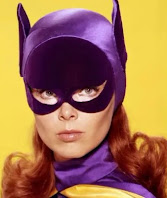
Seven Things to Know about Yvonne Craig

1. Yvonne Craig studied ballet at age 16 as the youngest member of The Ballet Russe de Monte Carlo. After three years, she left the company and wound up cast opposite Patrick Wayne (John's son) in 1959's The Young Land. Craig occasionally got opportunities to display her dancing skills in film and TV, most notably as a Russian ballerina dancing with James Coburn in the spy spoof In Like Flint (1967).

2. In the 1959 pilot episode of The Many Loves of Dobie Gillis, Yvonne Craig appeared in the opening credits in which Dobie (Dwayne Hickman) peeks through a hole in a fence at her and Myrna Fahey. When the series was picked up, that opening was replaced with an animated sequence of Dobie and the girls. Still, Yvonne guested on Dobie Gillis five times, playing characters such as rich girl Linda Sue Faversham.

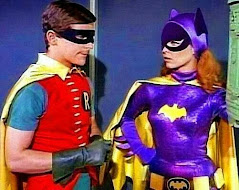
Batgirl with the Boy Wonder.
3. In 1968, ABC considered launching a Batgirl TV series with Yvonne Craig as the title character. A short "pilot" was produced, which also featured Batman (Adam West) and Robin (Burt Ward). Batgirl saves the Dynamic Duo from the Killer Moth, who traps them in a cocoon. When ABC rejected the idea of a separate series, Yvonne Craig's Batgirl was incorporated into the last season of Batman. For many years, the Batgirl pilot was available only on bootleg copies, but it was included as a bonus feature in a 2014 Batman boxed set.

4. Craig embraced her role as Batgirl. In a 2015 CNN interview, she stated: "I hear from women that I was their role model. When I was a little girl, I realized that girls could kick butt just like guys." She also found the experience to be a rewarding one. "I got to work with people that I would never have the chance to work with. We had Ethel Merman. I would never have met Milton Berle, I got to work with him, and he was a delight."

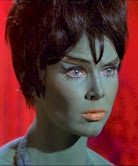
As Marta in Star Trek.
5. Yvonne Craig was a frequent guest star in 1960s and 1970s TV series, appearing in shows such as The Courtship of Eddie's Father, My Three Sons, 77 Sunset Strip, and Ben Casey (with one-time boyfriend Vince Edwards). She also starred in a third season episode of the original Star Trek series called "Whom Gods Destroy." She played a green-skinned female Orion--but she's not the green woman shown in Star Trek's closing credits. That's Susan Oliver in the guise of another Orion from the famous two-part episode "The Menagerie."

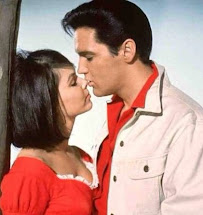
With Elvis in Kissin' Cousins.
6. Yvonne Craig and Deborah Walley shared several connections. Each of them appeared in a Gidget movie: Yvonne had a small role in the 1959 original and Deborah played the lead in Gidget Goes Hawaiian (1961). Deborah Walley appeared in the Beach Party movies Beach Blanket Bingo and The Ghost in the Invisible Bikini; Yvonne Craig appeared with Walley in the Frankie Avalon comedy Ski Party (1965). Yvonne starred with Elvis in two films: It Happened at the World's Fair (1963) and Kissin' Cousins (1964). Deborah Walley appeared with Elvis in Spinout (1966). Later in their careers, each actress voiced characters in animated TV series: Walley in Chip 'n' Dale Rescue Rangers and Yvonne Craig in Olivia

7. Yvonne Craig was married twice. The first marriage was to singer Jimmy Boyd ("I Saw Mommy Kissing Santa Claus") and lasted two years. She was later married to real estate investor Kenneth Aldrich from 1988 until her death in 2015 from breast cancer that had spread to her liver. In between her two marriages, Craig supposedly dated Robert Vaughn, Bill Bixby, Vince Edwards, Mort Sahl, and Elvis Presley. In 2000, she published her autobiography From Ballet to the Batcave and Beyond.

Monday, December 27, 2021

Top Ten Posts of 2021

As the year draws to a close, the Classic Film & TV Café traditionally ends it with a countdown of our ten most viewed posts. We published a total of 52 in 2021. Naturally, the countdown is a little skewed, since those posts that came out at the start of the year will have more views. But that won't stop us...we love year-end lists!

We included only posts that were originally published during 2021. We also omitted our monthly quizzes. To build a little suspense, we'll begin at No. 10 and work our way to No. 1.

But before we get started, we want to thank each of you who visited this blog this year and send some extra love to those who took the time to leave comments.

10. Ray Harryhausen's Valley of Gwangi 

 9.  Ranking All 25 James Bond Films from Best to Worst

 8. Jamie Lee Boards a Terror Train; The Animals Have Their Day

 7. Rodgers & Hammerstein Films: Ranked Best to Worst

 6. Michael Asimow Discusses His New Book on Truth and Trickery in Courtroom Movies

 5. Seven Things to Know About Burgess Meredith

 4. Seven Things to Know About Julie Newmar

 3. Celebrate National Classic Movie Day with the 6 Films - 6 Decades Blogathon!

 2. Seven Things to Know About William Hopper

 1. The Five Best Episodes of Banacek

Monday, December 20, 2021

The Movie Quote Game (Holiday Edition 2021)

This month, we're focusing on quotes from holiday movies--films that revolve around or take place during holidays. We will list a quote from a famous movie and ask you to name the movie. Try to answer these questions on your own without resorting to Google searches. As always, please answer no more than three questions per day so others can play.  If you have a response other than the intended one, just be able to defend it.

1.  "Mutual, I'm sure."

2.  "There are few people who know the secret of making a heaven here on earth. You are one of those rare people."

3.  "Why didn't you tell me I was in love with you?"

4.  "And Mrs. Claus has positively identified the kidnappers as Martians."

5.  "She was sort of a medium built, medium height. With a nice evening gown on with a belt in the back. She's sorta built like the girl I knew from the corner drugstore who used to play pinball. Conshwella Schlepkiss. I remember she was high man three weeks in a row."

6.  "You know my name, but who are you? Just another American who saw too many movies as a child? Another orphan of a bankrupt culture who thinks he's John Wayne? Rambo? Marshal Dillon?"

7.  "Everything is hunky-dunky!"

8.  "George, I am an old man, and most people hate me. But I don't like them either so that makes it all even."

9.  "Oh, Christmas isn't just a day, it's a frame of mind... and that's what's been changing. That's why I'm glad I'm here, maybe I can do something about it."

10. "William, Barney is dead. I shot him. I killed him. I shot him with this."  (This might be a difficult one to answer!)

11. "Some men are Baptists, others Catholics; my father was an Oldsmobile man."

12. "Well, what do you want me to do about it? If he's dying, he's dying."

13. "That's not the friggin' Christmas Star, Gris... It's the light at the sewerage treatment plant."

14. "I have known misfortune. Poverty. Humiliation. I've even known the shame of having to beg. But I have never received such an insult as you have just delivered. I have no price, young man--unless the value a man places upon his honor may be called be a price."

15. "I've positively decided we're going to get married at the earliest opportunity and I don't want to hear any arguments. That's final. I love you. Merry Christmas."

Monday, December 13, 2021

Sean, Gina, and $50 Million

Sean Connery as Tony.
Wheelchair-bound Charles Richmond mistreats his servants, bullies his adult nephew, and fosters tyranny wherever he goes. He is also worth $50 million.

With his inheritance limited to a mere $650,000, nephew Tony Richmond (Sean Connery) hatches a scheme to increase his share of the estate. He carefully selects a new nurse that will appeal to his uncle: an Italian beauty named Maria unwilling to tolerate Charles' cruelty. Her defiance and Tony's open criticism of her combine to peak Charles' interest. Tony is convinced that he can manipulate his uncle into marrying Maria (Gina Lollobrigida). She reluctantly agrees to Tony's plan--but who can trust whom?

Gina Lollobrigida as Maria.
Made in 1964, Woman of Straw is the kind of low-key thriller that Alfred Hitchcock might have made twenty years earlier. It's a tribute to the cast that they make the plot's double-crossing shenanigans interesting for most of the two-hour running time. Ralph Richardson is in top form as the despicable Charles, who shows no signs of humanity until he gradually develops feelings for Maria. Gina Lollobrigida is convincing, too, as the conflicted Maria who loses her taste for the scheme, but can't resist her attraction to Mark and his ambitions.

Ralph Richardson as Charles.
By today's standards, the biggest star in Woman of Straw is Sean Connery. But, in 1964, he was on the brink of international superstardom pending the release of Goldfinger later that year. He is adequate as the cold and calculating Mark, who somehow never elicits audience sympathy even after he reveals that Charles drove his father to suicide and then married his mother! It doesn't help that Connery's character fades to the background during the film's middle portion as the focus shifts to the Charles-Maria relationship.

Veteran director Basil Dearden takes advantage of the colorful locations shot in Majorca, Spain (though the use of rear screens in some scenes is distracting). However, he loses control of the film during its rambling final thirty minutes. There's really no reason for a movie like Woman of Straw to be two hours in length! One would think that Dearden, who directed such marvelous, efficient thrillers as Victim (1961), would know this. Additionally, it doesn't help that the climatic scene is a headscratcher that left my wife and me trying to figure out what happened.

The best reason to watch Woman of Straw is to see Gina Lollobrigida give one of her best English-language performances. Once dubbed "The Most Beautiful Woman in the World" (instead of Sophia Loren?), she had won several acting awards for her Italian films prior to Woman of Straw. It's unfortunate that she rarely got roles worthy of her talents in other English-language movies. She deserved better than being cast in light comedies opposite American stars like Rock Hudson and Bob Hope.

Monday, December 6, 2021

Classic Movies About Ballet

Moira Shearer in The Red Shoes.
The challenge of integrating a dynamic theatrical art form into the confines of cinema has proven to be a difficult task. Consequently, it has been undertaken almost exclusively by filmmakers/ballet lovers, whose artistic successes have been mixed equally with unmitigated failures.

British filmmakers Michael Powell and Emeric Pressburger produced two outstanding ballet films, with Powell also contributing a third, less memorable solo effort. The first Powell-Pressburger ballet film was 1948’s The Red Shoes, which starred real-life ballerina Moira Shearer as a young dancer driven to her death by her inability to choose between ballet and a “normal” life. The highlight of this dazzling, colorful film is a 14-minute ballet of Hans Christian Andersen’s fairy tale “The Red Shoes,” brilliantly danced and photographed against stylized sets. The elaborate sets returned in 1951’s Tales of Hoffman, a fusion of drama, singing, and ballet based on Offenbach’s opera and featuring ballerina Shearer again. Powell turned to ballet once more, sans Pressburger, in 1959’s all-but-forgotten Honeymoon, which featured excerpts from the Spanish ballets “Los Amantes de Teruel” and “El Amor Brujo.”

Leslie Caron & Gene Kelly in
An American in Paris.
The most interesting pre-Red Shoes ballet picture was The Specter of the Rose (1946), an offbeat drama about a young dancer who is slowly losing his mind. It featured a rare screen appearance by drama teacher Michael Chekhov and the potent presence of Dame Judith Anderson. Gene Kelly, after choreographing a modern ballet for a set-piece in An American in Paris (1951), incorporated ballet into his all-dance 1957 picture Invitation to the Dance. Shot in 1952, this three-part anthology boasted energetic dancing and clever direction (including a combination of live action and cartoon), but it crashed at the boxoffice and almost ended Kelly’s career. In contrast, Herbert Ross’s The Turning Point (1977) was a solid popular and critical favorite. Shirley MacLaine and Anne Bancroft had the starring roles as a pair of former ballerinas, but Mikhail Baryshnikov stole the film every time he took to the dance floor.

Ballets filmed in their entirety have been rare, but have nevertheless been captured in Peter Rabbit and the Tales of Beatrix Potter (1971), Nutcracker (1982), and Nutcracker: The Motion Picture (1986).

Margaret O'Brien in
The Unfinished Dance.
There have been numerous films, not expressly about ballet, which have featured ballerinas as principal characters. The role call of actresses who have played ballerinas is a varied one: Greta Garbo (Grand Hotel); Maureen O’Hara (Dance, Girl, Dance); Vivien Leigh (Waterloo Bridge); Loretta Young (The Men in Her Life); Margaret O’Brien (The Unfinished Dance); Janet Leigh (The Red Danube); Gene Tierney (Never Let Me Go); and Leslie Caron (Gaby).  (I think it's too early include the stars of The Black Swan....it's not a classic yet).

Ballet segments have highlighted many mainstream musicals, though the sequences in An American in Paris, Oklahoma!, and On Your Toes stand out. Films about ballet, or featuring notable scenes, include:

Grand Hotel (1932)
On Your Toes (1939)
Dance, Girl, Dance (1940)
Waterloo Bridge (1940)
The Men in Her Life (1941)
The Dancing Masters (1943)
Specter of the Rose (1946)
Carnival (1946)
The Unfinished Dance (1947)
The Imperfect Lady (1947)
The Red Shoes (1948)
The Red Danube (1949)
Illicit Interlude (aka Summer Play; Summer Interlude) (1950)
An American in Paris (1951)
Tales of Hoffman (1951)
Limelight (1952)
Never Let Me Go (1953)
Dance Little Lady (1955)
Oklahoma! (1955)
Gaby (1956)
Meet Me in Las Vegas (aka Viva Las Vegas) (1956)
Invitation to the Dance (1957)
Angel in a Taxi (1959)
Honeymoon (1959)
Vampire and the Ballerina (1962)
Peter Rabbit and the Tales of Beatrix Potter (aka The Tales of Beatrix Potter) (1971)
The Turning Point (1977)
Slow Dancing in the Big City (1978)
The Cowboy and the Ballerina (1984 TVM)
Nutcracker (1982)
Nutcracker: The Motion Picture (1986)
Dancers (1987)
Dancing for Mr. B: Six Balanchine Ballerinas (1989)

Monday, November 29, 2021

Walt Disney's Live-Action Robin Hood

Richard Todd as Robin.
The Adventures of Robin Hood (1938) is one of the greatest films ever made--with its perfectly-cast characters, vivid color, fabulous sets, and iconic scenes (e.g., the archery contest, the climatic swordfight). Thus, it's surprising that Walt Disney chose to mount his own version of the Robin Hood legend just fourteen years later. And yet, what's even more surprising is that The Story of Robin Hood and His Merrie Men (1952) is a lively, diverting yarn with its own charms. To be sure, it will always be overshadowed by the Warner Bros. classic, but it still stands proudly on its own.

Joan Rice as Marian.
In this version, Robin (Richard Todd) and Marian (Joan Rice) are childhood sweethearts who are separated when King Richard leaves to fight in the Crusades. Marian is placed under the protection of the Queen Mother in London, while Robin and his father remain in Nottingham. When Robin's father refuses to support greedy Prince John and his handpicked sheriff (Peter Finch), he is murdered and his son becomes an outlaw. Robin soon forms his band of merry men, who live in the forest and rob from the rich noblemen and give the spoils to their overtaxed countrymen.

There are the requisite encounters with Little John (James Robertson Justice) and Friar Tuck (James Hayter) before Marian returns in time to get imprisoned by Prince John. That development, plus a scheme to steal King Richard's ransom money, sets up the climax in this fast-paced, 84-minute adventure.

Peter Finch as the sheriff.
The British cast impresses from top to bottom, with Richard Todd making a likable hero, Joan Rice sparkling as a sweet Marian, and an almost unrecognizable Peter Finch as Robin's worthy adversary. It's too bad the big duel between Robin and the Sheriff of Nottingham seems like an afterthought (though the latter's demise is memorably gruesome, especially for a Disney film). 

The same applies to the scenes with James Hayter as Friar Tuck and James Robertson Justice as Little John. The latter made a career out of playing bigger-than-life characters in films such as Doctor in the House, but he has little (pun intended) to do here. On the other hand, musician Elton Hayes gets some choice scenes as traveling minstrel Alan-a-Dale. One almost wonders if he was Danny Kaye's inspiration for his Giacomo in The Court Jester.

The Story of Robin Hood and His Merrie Men was just Disney's second live-action film, following 1950's Treasure Island. Like that film, the production values are high, with scenes shot in the real Sherwood Forest blending effectively with set pieces filmed in Pinewood Studios. Really, though, Disney should restore some of its early live-action movies, as the once vibrant colors have faded on the even best quality prints.

Richard Todd appeared in two additional Disney pictures the following year: The Sword and the Rose and Rob Roy, The Highland Rogue. Both are fine escapist fare and co-star Justice and the always enchanting Glynis Johns. Nevertheless, they lack the strong narrative that comes with the Robin Hood legend. There's just something about watching the men and women of Sherwood Forest performing their derring-do.

Monday, November 22, 2021

The Movie Quote Game (November 2021)

This month, we're introducing a new game! We will list a quote from a famous movie and ask you to name the movie. Try to answer these questions on your own without resorting to Google searches. As always, please answer no more than three questions per day so others can play.  If you have a response other than the intended one, just be able to defend it.

1.  "Damn that Texan! When you need him, he's dead."

2.  "I didn't bring your breakfast, because you didn't eat your din-din!"

3.  "Your choice is simple: join us and live in peace, or pursue your present course and face obliteration."

4.  "There's nobody alive but us! And nobody's going to help us except ourselves. lt's up to each one of you. lt's up to all of us. Together."

5.  "I proved once and for all that the limb is mightier than the thumb."

6.  "This was no boat accident."

7.  "I can promise you one thing, I'll do nothing to disgrace the office of the United States Senate."

8.  "How can you trust a man that wears both a belt and suspenders? Man can't even trust his own pants."

9.  "Leiningen, you're up against a monster twenty miles long and two miles wide... forty square miles of agonizing death! You can't stop it!"

10. "You have yourself a few flings this summer. I bet you're quite a ladies' man, huh?"

11. "They can't make a fool out of Lina Lamont. They can't make a laughing stock out of Lina Lamont. What do they think I am? Dumb or something? Why, I make more money than...than...than Calvin Coolidge! Put together!"

12. "So few people can boast that they've lost a flying saucer and a man from Mars--all in the same day! Wonder what they'd have done to Columbus if he'd discovered America, and then mislaid it."

13. "There's nothing wrong with Ellen. It's just that she loves too much."

14. "All right then, run, lady, and you keep on running. Buy yourself a bus ticket and disappear. Change your name, dye your hair, get lost--and then maybe, just maybe, you're gonna be safe from me."

15. "In my case, self-absorption is completely justified. I have never discovered any other subject quite so worthy of my attention."

Monday, November 15, 2021

Seven Things to Know About George Sanders

1. In his autobiography Memoirs of a Professional Cad, George Sanders recalled his first film role in The Man Who Could Work Miracles (1937) as one of the gods: "The part called for me to ride half-naked and shiny with grease, at four o'clock in the morning during one of England's coldest winters, on a horse which was also coated with grease. Torin Thatcher and Ivan Brandt were the other two greasy gods. Though I never fancied myself as a horseman, I was the only one of the three that didn't fall off. In that regard at least I was already a successful film actor."

2. George Sanders was born in St. Petersburg, Russia, in 1906. His family moved to Great Britain in 1917. After studying at Brighton College and Manchester Technical College, Sanders worked in the textile industry and on a tobacco plantation in South America. On his return to Great Britain, he was working for Lever Brothers when his co-worker Greer Garson suggested he take up acting.

3. George Sanders was married four times. His second wife was Zsa Zsa Gabor (1949-54) and his fourth wife was Zsa Zsa's sister Magda Gabor (1970-71). That marriage only lasted for a month. In between, Sanders was married to actress Benita Hume, the widow of Ronald Colman, until her death in 1967. When asked about ex-husband Sanders, Zsa Zsa once said: "We were both in love with him. I fell out of love with him, but he didn't."

4. George Sanders played debonair detective Simon Templar in five films starting with The Saint Strikes Back in 1939. Sanders then transitioned to a similar "B" detective series in which he played another suave detective, Gay Lawrence aka The Falcon (loosely inspired by a Michael Arlen short story). By the time he had appeared in three Falcon movies, Sanders was in demand for "A" pictures. RKO wanted to continue The Falcon film series, so it made The Falcon's Brother (1942), in which Gay Lawrence is killed and his brother, Tom, takes over as The Falcon. The nifty part is that the role of Tom Lawrence was played by George Sander's real-life brother Tom Conway. He went on to star as The Falcon in nine more movies (see The Falcon and the Co-eds, easily the best in the series).

With Joan Fontaine and Judith Anderson in Rebecca.
5. Although Sanders' breakthrough role was in Hitchcock's Rebecca (1940), as the adulterous title character's lover, his first starring role wasn't until 1942. He played a stockbroker-turned-painter in The Moon and Sixpence, which co-starred Herbert Marshall and Doris Dudley (who made only four films). Subsequent roles, though, often typecast him as a cad--such as the married children's book author who romances Gene Tierney in The Ghost and Mrs. Muir (1947). He got another break in 1950 when he played a cynical theatre critic in Joseph L. Mankiewicz's All About Eve and won a Best Supporting Actor Oscar. Although Jose Ferrer was originally considered for the part, it's hard to imagine anyone other than George Sanders as the velvet-voiced, part-time narrator who introduces himself so memorably: "To those of you who do not read, attend the theater, listen to unsponsored radio programs, or know anything of the world in which you live, it is perhaps necessary to introduce myself. My name is Addison DeWitt. My native habitat is the theater. In it, I toil not, neither do I spin. I am a critic and commentator. I am essential to the theatre."

Elizabeth Taylor and George Sanders.
6. His Oscar win afforded him more choices in his next few roles. He got the opportunity to sing opposite Ethel Merman in Call Me Madam (1953). He played a well-written villain in love with Elizabeth Taylor's character in Ivanhoe (1952). He even hosted a short-lived, half-hour anthology TV series called The George Sanders Mystery Theatre in 1957 (also starring in one episode).

7. George Sanders was still acting at age 65 when he committed suicide in 1972. According to his New York Times obituary, he died of an overdose of sleeping pills and left the following note: "Dear World, I am leaving because I am bored. I feel I have lived long enough. I am leaving you with your worries in this sweet cesspool. Good luck."